> Antigen, Antibodies, ELISA, Western Blot > Primary Antibody > Polyclonal Antibodies > GDNF AntibodyBrand |
Leading Biology | Catalog Number |
APR12015G |
Product Type |
Polyclonal Antibodies | Field of Research |
|
Product Overview |
We constantly strive to ensure we provide our customers with the best antibodies. As a result of this work we offer this antibody in purified format.
We are in the process of updating our datasheets. If you have any questions regarding this update, please feel free to contact our technical support team.
This product is a high quality GDNF antibody.
|
||
Molecular Weight |
23720 Da
|
||
Host |
Rabbit
|
||
Species Reactivity |
Human, Rat
|
||
Target |
Peptide (C)DDNLVYHILRKHSAKR, corresponding to amino acid residues 192-207 of human GDNF (precursor) (Accession P39905). C-terminus of the mature GDNF.
|
||
GeneID |
|||
UniProt ID |
|||
Summary |
Glial cell-line derived neurotrophic factor (GDNF) is a neurotrophic factor originally identified for its ability to promote the survival of dopaminergic neurons in the midbrain.1GDNF is part of the neurotrophic factor family known as GDNF-family ligand (GFL), which includes neurturin (NRTN), artemin (ARTN), and persephin (PSPN).2,3The GFL ligands are structurally related to the transforming growth factor-b (TGF-b) protein superfamily and contain seven cysteine residues with the same relative spacing as other members of this family.2Typical of neurotrophic factors, GDNF is produced in the form of a precursor, preproGDNF, which is then cleaved during secretion to become proGDNF, and later processed to the mature (homodimeric) GDNF form.2The GFLs convey their activity by binding to a multicomponent receptor that includes the RET receptor tyrosine kinase and a glycosyl phosphatidylinositol (GPI)-linked ligand-binding subunit known as GDNF family receptor a (GFRa).2,3Four different GFRa subunits have been identified (GFRa 1-4) that determine the specificity of the GFRa-RET receptor complex. Thus, GFRa1 together with RET make up the high affinity receptor for GDNF.The GDNF and GFRa complex interaction with RET induces activation of the intracellular tyrosine kinase domain of the latter. Phosphorylated RET can then interact with several intracellular signaling cascades including MAP kinase, PI3K and PLCg signaling pathways.2,3 Lately a RET-independent signaling pathway for GDNF has been shown to involve binding of GDNF and GFRa to the neural cell adhesion molecule (NCAM). Signaling of GDNF via the NCAM complex stimulates intracellular tyrosine kinases such as Fyn and FAK.4GDNF is synthesized and secreted by a wide variety of cell types in the central and peripheral nervous system where it exerts its neurotrophic effects in the development and maintenance of distinct sets of neurons. Accordingly, GDNF knockout mice die shortly after birth, reflecting the central role of GDNF in neurodevelopment.2Remarkably, GDNF was found to be an essential morphogen for kidney formation as well as to have a role is spermatogenesis.3Abgent is pleased to offer a highly specific antibody directed against an epitope located near the C-terminal end of human GDNF. Anti-GDNF antibody (#AG1175) can be used in Western blot, immunocytochemical, and immunohistochemical applications and recognizes GDNF from human and rat samples.
|
||
Form |
Affinity purified antibody, Liquid |
||
Storage & Stability |
Store at +4°C short term. For long-term storage, aliquot and store at -20°C or below. Stable for 12 months at -20°C. Avoid repeated freeze-thaw cycles.
|
||
Applications |
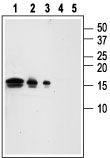
WB
|
||
Dilution |
WB~~1:200-1:2000
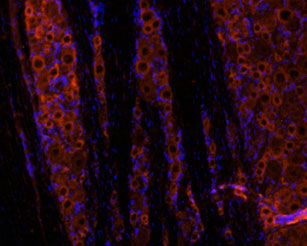
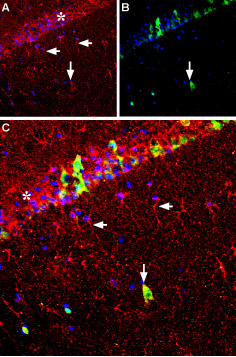
IHC~~1:100
ICC~~1:200
|
||
Synonyms |
Glial cell line-derived neurotrophic factor, hGDNF, Astrocyte-derived trophic factor, ATF, GDNF
|
||
Images |
|
||
Specification |
|||
Quantity |
|
||
| Select | Brand | Catalog No. | Product Name | Pack Size | Type | Field of Research | Specification | Quantity | Price(USD) | |
| 1 | Leading Biology | APR03440G | ITGA11 Antibody (N-term) | 100 μl | Polyclonal Antibodies |
|
$495.00 | Add Ask | ||
| 2 | Leading Biology | APR04537G | CMIP Antibody (C-term) | 100 μl | Polyclonal Antibodies |
|
$495.00 | Add Ask | ||
| 3 | Leading Biology | APR12422G | Human H4 Histamine Receptor (extracellular) Antibody | 50 μl | Polyclonal Antibodies |
|
$695.00 | Add Ask | ||
| 4 | Leading Biology | APR03844G | UBE2W Antibody (C-term) | 100 μl | Polyclonal Antibodies |
|
$495.00 | Add Ask | ||
| 5 | Leading Biology | APR04349G | HECTD2 Antibody (N-term) | 100 μl | Polyclonal Antibodies |
|
$495.00 | Add Ask | ||
| 6 | Leading Biology | APR03502G | IGHG1 Antibody (Center) | 100 μl | Polyclonal Antibodies |
|
$495.00 | Add Ask |
Leading Biology Inc.
2600 Hilltop DR, Building G, B Suite C138
Richmond, CA, 94806
Tel: 1-661-524(LBI)-0262
Email: info@leadingbiology.com

You have 0 item in your cart
You have 0 item in your inquiry list