> Antigen, Antibodies, ELISA, Western Blot > Primary Antibody > Polyclonal Antibodies > THRAP3 / TRAP150 Antibody (aa930-955)Brand |
Leading Biology | Catalog Number |
AMM08199G |
Product Type |
Polyclonal Antibodies | Field of Research |
|
Product Overview |
We constantly strive to ensure we provide our customers with the best antibodies. As a result of this work we offer this antibody in purified format.
We are in the process of updating our datasheets. If you have any questions regarding this update, please feel free to contact our technical support team.
This product is a high quality THRAP3 / TRAP150 antibody (aa930-955).
|
||
Molecular Weight |
109kDa
|
||
Cellular Localization |
Antigen Cellular Localization:
Nucleus
|
||
Host |
Rabbit
|
||
Species Reactivity |
Human, Mouse, Rat, Monkey, Horse, Xenopus, Bovine, Dog
|
||
Target |
A portion of amino acids 930-955 of human Thyroid hormone receptor associated protein 3
|
||
Symbol |
TRAP150
|
||
GeneID |
|||
UniProt ID |
|||
Function |
Involved in pre-mRNA splicing. Remains associated with spliced mRNA after splicing which probably involves interactions with the exon junction complex (EJC). Can trigger mRNA decay which seems to be independent of nonsense-mediated decay involving premature stop codons (PTC) recognition. May be involved in nuclear mRNA decay. Involved in regulation of signal-induced alternative splicing. During splicing of PTPRC/CD45 is proposed to sequester phosphorylated SFPQ from PTPRC/CD45 pre-mRNA in resting T-cells. Involved in cyclin-D1/CCND1 mRNA stability probably by acting as component of the SNARP complex which associates with both the 3'end of the CCND1 gene and its mRNA. Involved in response to DNA damage. Is excluced from DNA damage sites in a manner that parallels transcription inhibition; the function may involve the SNARP complex. Initially thought to play a role in transcriptional coactivation through its association with the TRAP complex; however, it is not regarded as a stable Mediator complex subunit. Cooperatively with HELZ2, enhances the transcriptional activation mediated by PPARG, maybe through the stabilization of the PPARG binding to DNA in presence of ligand. May play a role in the terminal stage of adipocyte differentiation. Plays a role in the positive regulation of the circadian clock. Acts as a coactivator of the CLOCK-ARNTL/BMAL1 heterodimer and promotes its transcriptional activator activity and binding to circadian target genes (PubMed:24043798).
|
||
Summary |
Involved in pre-mRNA splicing. Remains associated with spliced mRNA after splicing which probably involves interactions with the exon junction complex (EJC). Can trigger mRNA decay which seems to be independent of nonsense-mediated decay involving premature stop codons (PTC) recognition. May be involved in nuclear mRNA decay. Involved in regulation of signal-induced alternative splicing. During splicing of PTPRC/CD45 is proposed to sequester phosphorylated SFPQ from PTPRC/CD45 pre-mRNA in resting T-cells. Involved in cyclin-D1/CCND1 mRNA stability probably by acting as component of the SNARP complex which associates with both the 3'end of the CCND1 gene and its mRNA. Involved in response to DNA damage. Is excluced from DNA damage sites in a manner that parallels transcription inhibition; the function may involve the SNARP complex. Initially thought to play a role in transcriptional coactivation through its association with the TRAP complex; however, it is not regarded as a stable Mediator complex subunit. Cooperatively with HELZ2, enhances the transcriptional activation mediated by PPARG, maybe through the stabilization of the PPARG binding to DNA in presence of ligand. May play a role in the terminal stage of adipocyte differentiation. Plays a role in the positive regulation of the circadian clock. Acts as a coactivator of the CLOCK-ARNTL/BMAL1 heterodimer and promotes its transcriptional activator activity and binding to circadian target genes (PubMed:24043798).
|
||
Form |
Liquid |
||
Storage & Stability |
Store at +4°C short term. For long-term storage, aliquot and store at -20°C or below. Stable for 12 months at -20°C. Avoid repeated freeze-thaw cycles.
|
||
Applications |
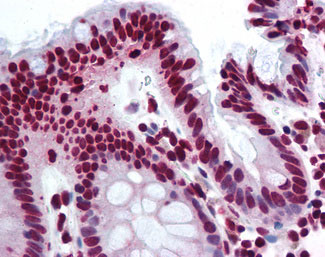
WB, IHC-P
|
||
Dilution |
IHC-P (10 μg/ml), WB (0.1-1 μg/ml),
|
||
Synonyms |
Thyroid hormone receptor-associated protein 3, Thyroid hormone receptor-associated protein complex 150 kDa component, Trap150, THRAP3, TRAP150
|
||
Images |
|
||
Specification |
|||
Quantity |
|
||
| Select | Brand | Catalog No. | Product Name | Pack Size | Type | Field of Research | Specification | Quantity | Price(USD) | |
| 1 | Leading Biology | APR03440G | ITGA11 Antibody (N-term) | 100 μl | Polyclonal Antibodies |
|
$495.00 | Add Ask | ||
| 2 | Leading Biology | APR04537G | CMIP Antibody (C-term) | 100 μl | Polyclonal Antibodies |
|
$495.00 | Add Ask | ||
| 3 | Leading Biology | APR12422G | Human H4 Histamine Receptor (extracellular) Antibody | 50 μl | Polyclonal Antibodies |
|
$695.00 | Add Ask | ||
| 4 | Leading Biology | APR04349G | HECTD2 Antibody (N-term) | 100 μl | Polyclonal Antibodies |
|
$495.00 | Add Ask | ||
| 5 | Leading Biology | APR03844G | UBE2W Antibody (C-term) | 100 μl | Polyclonal Antibodies |
|
$495.00 | Add Ask | ||
| 6 | Leading Biology | APR03502G | IGHG1 Antibody (Center) | 100 μl | Polyclonal Antibodies |
|
$495.00 | Add Ask |
Leading Biology Inc.
2600 Hilltop DR, Building G, B Suite C138
Richmond, CA, 94806
Tel: 1-661-524(LBI)-0262
Email: info@leadingbiology.com

You have 0 item in your cart
You have 0 item in your inquiry list