> Antigen, Antibodies, ELISA, Western Blot > Primary Antibody > Polyclonal Antibodies > SLC26A6 Antibody (internal region)Brand |
Leading Biology | Catalog Number |
APR10023G |
Product Type |
Polyclonal Antibodies | Field of Research |
|
Product Overview |
We constantly strive to ensure we provide our customers with the best antibodies. As a result of this work we offer this antibody in purified format.
We are in the process of updating our datasheets. If you have any questions regarding this update, please feel free to contact our technical support team.
This product is a high quality SLC26A6 antibody (internal region).
|
||
Molecular Weight |
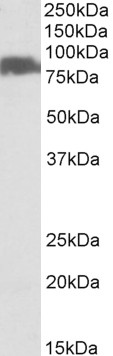
82967 Da
|
||
Cellular Localization |
Antigen Cellular Localization:
Cell membrane; Multi-pass membrane protein. Membrane; Multi-pass membrane protein. Apical cell membrane; Multi-pass membrane protein Cytoplasmic vesicle membrane; Multi-pass membrane protein. Microsome. Note=Localized in sperm membranes. Colocalizes with CFTR at the midpiece of sperm tail. Localizes to the apical membrane brush border of epithelial cells in the proximal tubules of kidney, of enterocytes of the small intestine and of gastric parietal cells in the stomach. May be translocated from the cytosolic surface of the cell membrane to the intracellular space by PKC in phorbol myristate acetate (PMA)- induced cells (By similarity). Colocalized with CA2 at the surface of the cell membrane in order to form a bicarbonate transport metabolon; colocalization is reduced in phorbol myristate acetate (PMA)-induced cells. Isoform 5: Cell membrane; Multi-pass membrane protein
|
||
Host |
Goat
|
||
Species Reactivity |
Human, Mouse
|
||
Isotype |
IgG
|
||
GeneID |
|||
UniProt ID |
|||
Function |
Apical membrane anion-exchanger with wide epithelial distribution that plays a role as a component of the pH buffering system for maintaining acid-base homeostasis. Acts as a versatile DIDS-sensitive inorganic and organic anion transporter that mediates the uptake of monovalent anions like chloride, bicarbonate, formate and hydroxyl ion and divalent anions like sulfate and oxalate. Function in multiple exchange modes involving pairs of these anions, which include chloride-bicarbonate, chloride-oxalate, oxalate-formate, oxalate-sulfate and chloride- formate exchange. Apical membrane chloride-bicarbonate exchanger that mediates luminal chloride absorption and bicarbonate secretion by the small intestinal brush border membrane and contributes to intracellular pH regulation in the duodenal upper villous epithelium during proton-coupled peptide absorption, possibly by providing a bicarbonate import pathway. Mediates also intestinal chloride absorption and oxalate secretion, thereby preventing hyperoxaluria and calcium oxalate urolithiasis. Transepithelial oxalate secretion, chloride-formate, chloride- oxalate and chloride-bicarbonate transport activities in the duodenum are inhibited by PKC activation in a calcium-independent manner. The apical membrane chloride-bicarbonate exchanger provides also a major route for fluid and bicarbonate secretion into the proximal tubules of the kidney as well as into the proximal part of the interlobular pancreatic ductal tree, where it mediates electrogenic chloride-bicarbonate exchange with a chloride-bicarbonate stoichiometry of 1:2, and hence will dilute and alkalinize protein-rich acinar secretion. Mediates also the transcellular sulfate absorption and oxalate secretion across the apical membrane in the duodenum and the formate ion efflux at the apical brush border of cells in the proximal tubules of kidney. Plays a role in sperm capacitation by increasing intracellular pH.
|
||
Summary |
This antibody is expected to recognize isoform 1, 2, 3 and 4 (NP_075062.2; NP_599025.2; NP_602298.2; NP_001035544.1).
|
||
Form |
0.5 mg/ml in Tris saline, 0.02% sodium azide, pH7.3 with 0.5% bovine serum albumin |
||
Storage & Stability |
Store at +4°C short term. For long-term storage, aliquot and store at -20°C or below. Stable for 12 months at -20°C. Avoid repeated freeze-thaw cycles.
|
||
Applications |
WB, E
|
||
Synonyms |
Solute carrier family 26 member 6, Anion exchange transporter, Pendrin-like protein 1, Pendrin-L1, SLC26A6
|
||
Images |
|
||
Specification |
|||
Quantity |
|
||
| Select | Brand | Catalog No. | Product Name | Pack Size | Type | Field of Research | Specification | Quantity | Price(USD) | |
| 1 | Leading Biology | APR03440G | ITGA11 Antibody (N-term) | 100 μl | Polyclonal Antibodies |
|
$495.00 | Add Ask | ||
| 2 | Leading Biology | APR04537G | CMIP Antibody (C-term) | 100 μl | Polyclonal Antibodies |
|
$495.00 | Add Ask | ||
| 3 | Leading Biology | APR12422G | Human H4 Histamine Receptor (extracellular) Antibody | 50 μl | Polyclonal Antibodies |
|
$695.00 | Add Ask | ||
| 4 | Leading Biology | APR04349G | HECTD2 Antibody (N-term) | 100 μl | Polyclonal Antibodies |
|
$495.00 | Add Ask | ||
| 5 | Leading Biology | APR03844G | UBE2W Antibody (C-term) | 100 μl | Polyclonal Antibodies |
|
$495.00 | Add Ask | ||
| 6 | Leading Biology | APR03502G | IGHG1 Antibody (Center) | 100 μl | Polyclonal Antibodies |
|
$495.00 | Add Ask |
Leading Biology Inc.
2600 Hilltop DR, Building G, B Suite C138
Richmond, CA, 94806
Tel: 1-661-524(LBI)-0262
Email: info@leadingbiology.com

You have 0 item in your cart
You have 0 item in your inquiry list