> Antigen, Antibodies, ELISA, Western Blot > Primary Antibody > Polyclonal Antibodies > CRYBA1 Antibody (Center)Brand |
Leading Biology | Catalog Number |
AMM05802G |
Product Type |
Polyclonal Antibodies | Field of Research |
|
Product Overview |
We constantly strive to ensure we provide our customers with the best antibodies. As a result of this work we offer this antibody in purified format.
We are in the process of updating our datasheets. If you have any questions regarding this update, please feel free to contact our technical support team.
This product is a high quality CRYBA1 antibody (Center).
|
||
Molecular Weight |
25150 Da
|
||
Host |
Rabbit
|
||
Species Reactivity |
Human, Mouse
|
||
Immunogen |
104-133 aa
|
||
Target |
This CRYBA1 antibody is generated from rabbits immunized with a KLH conjugated synthetic peptide between 104-133 amino acids from the Central region of human CRYBA1.
|
||
Isotype |
Rabbit Ig
|
||
Symbol |
CRYB1
|
||
GeneID |
|||
UniProt ID |
|||
Function |
Crystallins are the dominant structural components of the vertebrate eye lens.
|
||
Summary |
Crystallins are separated into two classes:taxon-specific, or enzyme, and ubiquitous. The latter classconstitutes the major proteins of vertebrate eye lens and maintainsthe transparency and refractive index of the lens. Since lenscentral fiber cells lose their nuclei during development, thesecrystallins are made and then retained throughout life, making themextremely stable proteins. Mammalian lens crystallins are dividedinto alpha, beta, and gamma families; beta and gamma crystallinsare also considered as a superfamily. Alpha and beta families arefurther divided into acidic and basic groups. Seven protein regionsexist in crystallins: four homologous motifs, a connecting peptide,and N- and C-terminal extensions. Beta-crystallins, the mostheterogeneous, differ by the presence of the C-terminal extension(present in the basic group, none in the acidic group).Beta-crystallins form aggregates of different sizes and are able toself-associate to form dimers or to form heterodimers with otherbeta-crystallins. This gene, a beta acidic group member, encodestwo proteins (crystallin, beta A3 and crystallin, beta A1) from asingle mRNA, the latter protein is 17 aa shorter than crystallin,beta A3 and is generated by use of an alternate translationinitiation site. Deletion of exons 3 and 4 causes the autosomaldominant disease 'zonular cataract with sutural opacities'.
|
||
Form |
Purified polyclonal antibody supplied in PBS with 0.09% (W/V) sodium azide. This antibody is purified through a protein A column, followed by peptide affinity purification. |
||
Storage & Stability |
Store at +4°C short term. For long-term storage, aliquot and store at -20°C or below. Stable for 12 months at -20°C. Avoid repeated freeze-thaw cycles.
|
||
Applications |
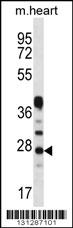
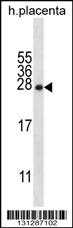
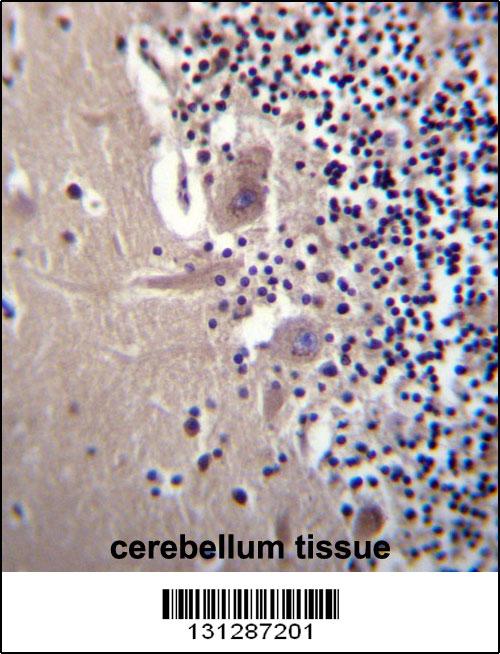
WB, IHC-P, E
|
||
Dilution |
WB~~1:1000
IHC-P~~1:10~50
|
||
Synonyms |
Beta-crystallin A3, Beta-crystallin A3, isoform A1, Delta4 form, Beta-crystallin A3, isoform A1, Delta7 form, Beta-crystallin A3, isoform A1, Delta8 form, CRYBA1, CRYB1
|
||
Images |
|
||
Specification |
|||
Quantity |
|
||
| Select | Brand | Catalog No. | Product Name | Pack Size | Type | Field of Research | Specification | Quantity | Price(USD) | |
| 1 | Leading Biology | APR03440G | ITGA11 Antibody (N-term) | 100 μl | Polyclonal Antibodies |
|
$495.00 | Add Ask | ||
| 2 | Leading Biology | APR04537G | CMIP Antibody (C-term) | 100 μl | Polyclonal Antibodies |
|
$495.00 | Add Ask | ||
| 3 | Leading Biology | APR12422G | Human H4 Histamine Receptor (extracellular) Antibody | 50 μl | Polyclonal Antibodies |
|
$695.00 | Add Ask | ||
| 4 | Leading Biology | APR03844G | UBE2W Antibody (C-term) | 100 μl | Polyclonal Antibodies |
|
$495.00 | Add Ask | ||
| 5 | Leading Biology | APR04349G | HECTD2 Antibody (N-term) | 100 μl | Polyclonal Antibodies |
|
$495.00 | Add Ask | ||
| 6 | Leading Biology | APR03502G | IGHG1 Antibody (Center) | 100 μl | Polyclonal Antibodies |
|
$495.00 | Add Ask |
Leading Biology Inc.
2600 Hilltop DR, Building G, B Suite C138
Richmond, CA, 94806
Tel: 1-661-524(LBI)-0262
Email: info@leadingbiology.com

You have 0 item in your cart
You have 0 item in your inquiry list