> Antigen, Antibodies, ELISA, Western Blot > Primary Antibody > Polyclonal Antibodies > PARC AntibodyBrand |
Leading Biology | Catalog Number |
APR06321G |
Product Type |
Polyclonal Antibodies | Field of Research |
|
Product Overview |
We constantly strive to ensure we provide our customers with the best antibodies. As a result of this work we offer this antibody in purified format.
We are in the process of updating our datasheets. If you have any questions regarding this update, please feel free to contact our technical support team.
This product is a high quality PARC Antibody.
|
||
Molecular Weight |
281229 Da
|
||
Cellular Localization |
Antigen Cellular Localization:
Cytoplasm.
|
||
Host |
Rabbit
|
||
Species Reactivity |
Human, Mouse
|
||
Target |
CUL9;
|
||
Isotype |
IgG
|
||
Symbol |
H7AP1, KIAA0708, PARC
|
||
GeneID |
|||
UniProt ID |
|||
Function |
Core component of a Cul9-RING ubiquitin-protein ligase complex, a complex that mediates ubiquitination and subsequent degradation of BIRC5 and is required to maintain microtubule dynamics and genome integrity. Acts downstream of the 3M complex, which inhibits CUL9 activity, leading to prevent ubiquitination of BIRC5 (PubMed:24793696). Cytoplasmic anchor protein in p53/TP53- associated protein complex. Regulates the subcellular localization of p53/TP53 and subsequent function (PubMed:12526791, PubMed:17332328).
|
||
Summary |
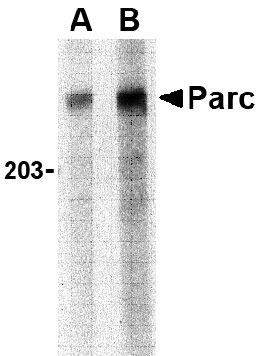
PARC Antibody: The continued localization of p53 to the nucleus is essential for its function as a tumor suppressor. PARC, a large, Parkin-like ubiquitin ligase has recently been identified as a cytoplasmic anchor protein in p53-associated protein complexes. In the absence of stress, PARC inactivation results in nuclear localization of p53 and activation of p53-dependent apoptosis, while overexpression of this protein promoted cytoplasmic sequestration of p53. Surprisingly, PARC knockout mice were viable and exhibited no obvious phenotype, suggesting that other proteins, such as the highly related cullin family of E3 ubiquitin ligases, may perform similar functions in the absence of PARC. Additionally, it has been suggested that p53 binding to PARC may serve to control PARC function.
|
||
Storage & Stability |
Store at +4°C short term. For long-term storage, aliquot and store at -20°C or below. Stable for 12 months at -20°C. Avoid repeated freeze-thaw cycles.
|
||
Applications |
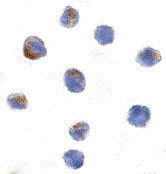
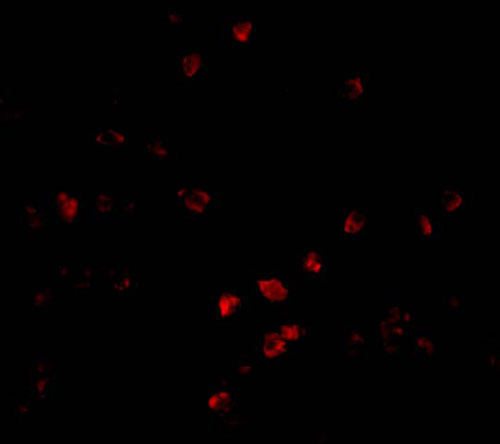
WB, IF, ICC, E
|
||
Images |
|
||
Specification |
|||
Quantity |
|
||
| Select | Brand | Catalog No. | Product Name | Pack Size | Type | Field of Research | Specification | Quantity | Price(USD) | |
| 1 | Leading Biology | APR03440G | ITGA11 Antibody (N-term) | 100 μl | Polyclonal Antibodies |
|
$495.00 | Add Ask | ||
| 2 | Leading Biology | APR04537G | CMIP Antibody (C-term) | 100 μl | Polyclonal Antibodies |
|
$495.00 | Add Ask | ||
| 3 | Leading Biology | APR12422G | Human H4 Histamine Receptor (extracellular) Antibody | 50 μl | Polyclonal Antibodies |
|
$695.00 | Add Ask | ||
| 4 | Leading Biology | APR04349G | HECTD2 Antibody (N-term) | 100 μl | Polyclonal Antibodies |
|
$495.00 | Add Ask | ||
| 5 | Leading Biology | APR03844G | UBE2W Antibody (C-term) | 100 μl | Polyclonal Antibodies |
|
$495.00 | Add Ask | ||
| 6 | Leading Biology | APR03502G | IGHG1 Antibody (Center) | 100 μl | Polyclonal Antibodies |
|
$495.00 | Add Ask |
Leading Biology Inc.
2600 Hilltop DR, Building G, B Suite C138
Richmond, CA, 94806
Tel: 1-661-524(LBI)-0262
Email: info@leadingbiology.com

You have 0 item in your cart
You have 0 item in your inquiry list