> Antigen, Antibodies, ELISA, Western Blot > Primary Antibody > Polyclonal Antibodies > CCR7 (extracellular) AntibodyBrand |
Leading Biology | Catalog Number |
APR15284G |
Product Type |
Polyclonal Antibodies | Field of Research |
|
Product Overview |
We constantly strive to ensure we provide our customers with the best antibodies. As a result of this work we offer this antibody in purified format.
We are in the process of updating our datasheets. If you have any questions regarding this update, please feel free to contact our technical support team.
This product is a high quality CCR7 (extracellular) antibody.
|
||
Molecular Weight |
42874 Da
|
||
Host |
Rabbit
|
||
Species Reactivity |
Human, Mouse
|
||
Target |
Peptide (C)DEVTDDYIGDNTTVD, corresponding to amino acid residues 26-40 of human CCR7 (Accession P32248). Extracellular, N-terminus.
|
||
GeneID |
|||
UniProt ID |
|||
Summary |
Chemokines (CHEMOtactic cytoKINES) are an important subgroup of the inflammatory cytokine family. More than fifty chemokines are expressed in mammalian cells and are characterized by their relatively small size (~70-90 amino acids), by their conserved N-terminus and cysteine motifs. This group of proteins has been further categorized on the basis of the cysteine spacing in the motifs creating C, CC, CXC, and CX3C chemokine subfamilies1,2. All fifty chemokines exert their effects through twenty different chemokine receptors, belonging to the superfamily of G-protein coupled receptors (GPCRs) suggesting a certain level of promiscuity among the different receptors. All chemokine receptors couple to the pertussis sensitive Gi protein leading to phospholipase C activation and adenylate cyclase inhibition3. Chemokines were first identified by their ability to mediate leukocyte chemoattraction. Apart from regulating the migration of leukocytes, they seem to be major players during inflammation and immunity4-6. Indeed, chemokines could also be further classified as being inflammatory as many chemokines are extensively upregulated in response to inflammation, or housekeeping important for the homeostasis of certain cell types. Inflammatory chemokines are responsible for recruiting immune cells to the inflamed region, and housekeeping chemokines, expressed in lymphoid or non-lymphoid tissues mediate the trafficking and targeting of cells7,8. In general, chemokines and their receptors guide leukocytes to sites of infection/inflammation. However, cases of chronic inflammatory disease and tissue damage occur when there is excessive recruitment of leukocytes. They could also be involved in the pathogenesis of neurological diseases like multiple sclerosis and many inflammatory diseases like atherosclerosis and inflammatory bowel disease. Recently, chemokines and their receptors have been found to be involved in cancer metastasis, namely breast cancer1. The chemokine signaling also seems to be important for the communication between neural cells and the immune system, especially in the context of infection. CCR7 receptor is responsible for directing dendritic cell migration to the lymph nodes where they are important for initiating the immune response. This receptor has two ligands, CCL19 and CCL21 which are expressed by stromal cells in the T cell-rich lymph node area9-11.Abgent is pleased to offer a highly specific antibody directed against an epitope of human CCR7. Anti-CCR7 (extracellular) antibody (#AG1295) can be used in western blot analysis and indirect flow cytometry applications and has been designed to recognize CCR7 from mouse, rat and human samples.
|
||
Form |
Affinity purified antibody, Liquid |
||
Storage & Stability |
Store at +4°C short term. For long-term storage, aliquot and store at -20°C or below. Stable for 12 months at -20°C. Avoid repeated freeze-thaw cycles.
|
||
Applications |
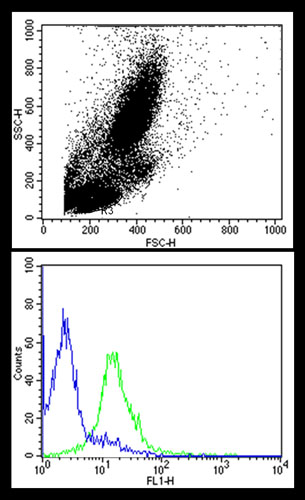
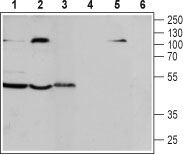
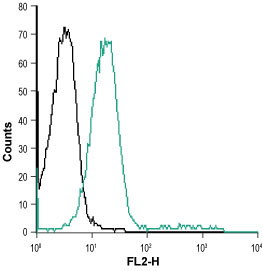
FC, WB
|
||
Dilution |
FC~~1:80
WB~~1:200-1:2000
|
||
Synonyms |
C-C chemokine receptor type 7, C-C CKR-7, CC-CKR-7, CCR-7, BLR2, CDw197, Epstein-Barr virus-induced G-protein coupled receptor 1, EBI1, EBV-induced G-protein coupled receptor 1, MIP-3 beta receptor, CD197, CCR7, CMKBR7, EBI1, EVI1
|
||
Images |
|
||
Specification |
|||
Quantity |
|
||
| Select | Brand | Catalog No. | Product Name | Pack Size | Type | Field of Research | Specification | Quantity | Price(USD) | |
| 1 | Leading Biology | APR03440G | ITGA11 Antibody (N-term) | 100 μl | Polyclonal Antibodies |
|
$495.00 | Add Ask | ||
| 2 | Leading Biology | APR04537G | CMIP Antibody (C-term) | 100 μl | Polyclonal Antibodies |
|
$495.00 | Add Ask | ||
| 3 | Leading Biology | APR12422G | Human H4 Histamine Receptor (extracellular) Antibody | 50 μl | Polyclonal Antibodies |
|
$695.00 | Add Ask | ||
| 4 | Leading Biology | APR04349G | HECTD2 Antibody (N-term) | 100 μl | Polyclonal Antibodies |
|
$495.00 | Add Ask | ||
| 5 | Leading Biology | APR03844G | UBE2W Antibody (C-term) | 100 μl | Polyclonal Antibodies |
|
$495.00 | Add Ask | ||
| 6 | Leading Biology | APR03502G | IGHG1 Antibody (Center) | 100 μl | Polyclonal Antibodies |
|
$495.00 | Add Ask |
Leading Biology Inc.
2600 Hilltop DR, Building G, B Suite C138
Richmond, CA, 94806
Tel: 1-661-524(LBI)-0262
Email: info@leadingbiology.com

You have 0 item in your cart
You have 0 item in your inquiry list