> Antigen, Antibodies, ELISA, Western Blot > Primary Antibody > Polyclonal Antibodies > Na+/Ca2+ Exchanger 3 (NCX-3) AntibodyBrand |
Leading Biology | Catalog Number |
APC00087G |
Product Type |
Polyclonal Antibodies | Field of Research |
|
Product Overview |
We constantly strive to ensure we provide our customers with the best antibodies. As a result of this work we offer this antibody in purified format.
We are in the process of updating our datasheets. If you have any questions regarding this update, please feel free to contact our technical support team.
This product is a high quality Na+/Ca2+ Exchanger 3 (NCX-3) antibody.
|
||
Molecular Weight |
103163 Da
|
||
Host |
Rabbit
|
||
Species Reactivity |
Human, Mouse, Rat
|
||
Target |
Peptide (C)PLEGKEVDESRRE, corresponding to amino acid residues 303- 315 of rat NCX-3 (Accession P70549). 3rd intracellular loop.
|
||
GeneID |
|||
UniProt ID |
|||
Summary |
Ca2+has proven to be a universal signaling molecule in excitable and non-excitable cells. However, being that its intracellular concentration is 1000 time lower than the extracellular milieu, it is important for the cell to keep this ratio for proper function. NCX, a Na+/Ca2+exchanger is responsible for most of the efflux of Ca2+out from the cell1-3. The NCX transporter is a member of the SLC8 family of solute carriers which in turn belong to the CaCA superfamily1,4,5.NCX-1 is one of three Na+/Ca2+exchangers (NCX-1, NCX-2, NCX-3) leading to one Ca2+movement across the plasma membrane in exchange of three Na+ influx. However, the transporter can reverse the direction of the transport if the concentrations of Na+and Ca2+change6. The transporter has nine transmembrane domains and intracellular N- and C-terminals. Between tansmembrane domains 5 and 6, the presence of an extra-long intracellular loop, termed the f loop is responsible for regulating the activity of NCX-1 via several different mechanisms like ion binding, phosphorylation, etc. The f loop also has sites which undergo alternative splicing7.Of the three NCX-1 expressed in mammalian cells, NCX-1 is the most widely expressed. Its expression is detected in the heart, brain, and kidney. NCX-1 undergoes alternative splicing in a tissue dependent manner. The first splice region does not change the overall structure of the protein but rather enables the expression of the gene specific to the tissues which require the expression of the gene. The second splicing site leads to a number of proteins varying in length. NCX-2 expression is much more limited; it is expressed only in neurons. NCX-3 is expressed in skeletal muscle and in some regions of the brain and undergoes alternative splicing in a similar fashion to that of NCX-11,8.Due to its central role in modulating Ca2+levels in the cell, NCX exchangers are involved in various pathophysiological diseases/disorders such as hypoxia, aging, alzheimer’s7, to name a few.
|
||
Form |
Affinity purified antibody, Liquid |
||
Storage & Stability |
Store at +4°C short term. For long-term storage, aliquot and store at -20°C or below. Stable for 12 months at -20°C. Avoid repeated freeze-thaw cycles.
|
||
Applications |
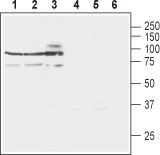
WB
|
||
Dilution |
WB~~1:200-1:2000
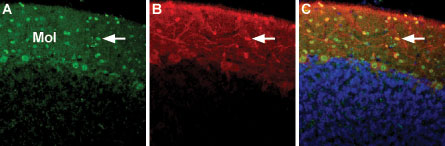
IHC~~1:100
|
||
Synonyms |
Sodium/calcium exchanger 3, Na(+)/Ca(2+)-exchange protein 3, Solute carrier family 8 member 3, Slc8a3, Ncx3
|
||
Images |
|
||
Specification |
|||
Quantity |
|
||
| Select | Brand | Catalog No. | Product Name | Pack Size | Type | Field of Research | Specification | Quantity | Price(USD) | |
| 1 | Leading Biology | APR03440G | ITGA11 Antibody (N-term) | 100 μl | Polyclonal Antibodies |
|
$495.00 | Add Ask | ||
| 2 | Leading Biology | APR04537G | CMIP Antibody (C-term) | 100 μl | Polyclonal Antibodies |
|
$495.00 | Add Ask | ||
| 3 | Leading Biology | APR12422G | Human H4 Histamine Receptor (extracellular) Antibody | 50 μl | Polyclonal Antibodies |
|
$695.00 | Add Ask | ||
| 4 | Leading Biology | APR04349G | HECTD2 Antibody (N-term) | 100 μl | Polyclonal Antibodies |
|
$495.00 | Add Ask | ||
| 5 | Leading Biology | APR03844G | UBE2W Antibody (C-term) | 100 μl | Polyclonal Antibodies |
|
$495.00 | Add Ask | ||
| 6 | Leading Biology | APR03502G | IGHG1 Antibody (Center) | 100 μl | Polyclonal Antibodies |
|
$495.00 | Add Ask |
Leading Biology Inc.
2600 Hilltop DR, Building G, B Suite C138
Richmond, CA, 94806
Tel: 1-661-524(LBI)-0262
Email: info@leadingbiology.com

You have 0 item in your cart
You have 0 item in your inquiry list