> Antigen, Antibodies, ELISA, Western Blot > Primary Antibody > Polyclonal Antibodies > Protease-activated Receptor-2 AntibodyBrand |
Leading Biology | Catalog Number |
AMM07348G |
Product Type |
Polyclonal Antibodies | Field of Research |
|
Product Overview |
We constantly strive to ensure we provide our customers with the best antibodies. As a result of this work we offer this antibody in purified format.
We are in the process of updating our datasheets. If you have any questions regarding this update, please feel free to contact our technical support team.
This product is a high quality Protease-activated Receptor-2 antibody.
|
||
Molecular Weight |
44441 Da
|
||
Host |
Rabbit
|
||
Species Reactivity |
Human, Mouse, Rat
|
||
Target |
Peptide (C)KRMQISLTSNKFSRK, corresponding to amino acid residues 368-382 of rat PAR-2 (Accession Q63645). Intracelluar, C- terminus.
|
||
GeneID |
|||
UniProt ID |
|||
Summary |
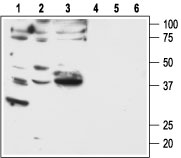
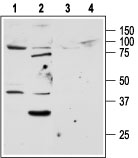
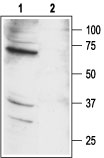
Protease-activated receptor 2 (PAR-2) belongs to a family of four G protein-coupled receptors (PAR-1 - 4) that are activated as a result of proteolytic cleavage by certain serine proteases, hence their name. In this novel modality of activation, a specific protease cleaves the PAR receptor within a defined sequence in its extracellular N-terminal domain. This results in the creation of a new N-terminal tethered ligand, which subsequently binds to a site in the second extracellular loop of the same receptor. This binding results in the coupling of the receptor to G proteins and in the activation of several signal transduction pathways.1-3Different PARs are activated by different proteases. Hence, PAR-1 is activated by thrombin, as are PAR-3 and PAR-4.1-3 PAR-2 is the only PAR family receptor that is activated by trypsin and not by thrombin. PAR-2 can be also cleaved and activated by other proteases such as tryptase, membrane-type serine protease 1, protease 3, and others.1-3The intramolecular nature of PAR activation and the continuous presence of the tethered ligand that cannot diffuse away imply the existence of several mechanisms for the rapid termination of PAR signaling. Indeed, following receptor activation, there is rapid phosphorylation of the C-terminal end of the receptor, followed by receptor internalization and degradation. In addition, several proteases can cleave away the tethered ligand, thereby “disarming” the PAR.1-3PAR-2-mediated intracellular signaling has not been clearly elucidated, but activators of PAR-2 induce generation of IP3 and mobilization of intracellular Ca2+. Activation of the ERK1/2 and NF-kB intracellular pathways following PAR-2 activation has been also described.1-3Tissue distribution of PAR-2 is wide with the highest expression levels found in pancreas, small intestine, liver and kidney. In addition, PAR-2 expression was observed in dorsal root ganglion neurons, smooth muscle cells and endothelial cells.The physiological role of PAR-2 is not clearly understood, however studies using PAR-2 knockout mice have suggested roles in the cardiovascular, pulmonary and gastrointestinal systems. Several studies suggest that PAR-2 plays a central role in inflammatory diseases and nociceptive pain transduction; hence PAR-2 blockers have been proposed to be useful in the therapeutic control of inflammation and pain.1-3Abgent is pleased to offer a highly specific antibody directed against an epitope at the intracellular C-terminus of the rat protease-activated receptor-2. Anti-Protease-activated Receptor-2 antibody (#AG1058) can be used in western blot analysis and immunocytochemical applications, and has been tested in rat, mouse and human samples.
|
||
Form |
Affinity purified antibody, Liquid |
||
Storage & Stability |
Store at +4°C short term. For long-term storage, aliquot and store at -20°C or below. Stable for 12 months at -20°C. Avoid repeated freeze-thaw cycles.
|
||
Applications |
WB
|
||
Dilution |
WB~~1:200-1:2000
ICC~~1:500
|
||
Synonyms |
Proteinase-activated receptor 2, PAR-2, Coagulation factor II receptor-like 1, Thrombin receptor-like 1, F2rl1, Par2
|
||
Images |
|
||
Specification |
|||
Quantity |
|
||
| Select | Brand | Catalog No. | Product Name | Pack Size | Type | Field of Research | Specification | Quantity | Price(USD) | |
| 1 | Leading Biology | APR03440G | ITGA11 Antibody (N-term) | 100 μl | Polyclonal Antibodies |
|
$495.00 | Add Ask | ||
| 2 | Leading Biology | APR04537G | CMIP Antibody (C-term) | 100 μl | Polyclonal Antibodies |
|
$495.00 | Add Ask | ||
| 3 | Leading Biology | APR12422G | Human H4 Histamine Receptor (extracellular) Antibody | 50 μl | Polyclonal Antibodies |
|
$695.00 | Add Ask | ||
| 4 | Leading Biology | APR04349G | HECTD2 Antibody (N-term) | 100 μl | Polyclonal Antibodies |
|
$495.00 | Add Ask | ||
| 5 | Leading Biology | APR03844G | UBE2W Antibody (C-term) | 100 μl | Polyclonal Antibodies |
|
$495.00 | Add Ask | ||
| 6 | Leading Biology | APR03502G | IGHG1 Antibody (Center) | 100 μl | Polyclonal Antibodies |
|
$495.00 | Add Ask |
Leading Biology Inc.
2600 Hilltop DR, Building G, B Suite C138
Richmond, CA, 94806
Tel: 1-661-524(LBI)-0262
Email: info@leadingbiology.com

You have 0 item in your cart
You have 0 item in your inquiry list