> Antigen, Antibodies, ELISA, Western Blot > Primary Antibody > Polyclonal Antibodies > Goat Anti-RGS14 AntibodyBrand |
Leading Biology | Catalog Number |
APR16377G |
Product Type |
Polyclonal Antibodies | Field of Research |
|
Product Overview |
We constantly strive to ensure we provide our customers with the best antibodies. As a result of this work we offer this antibody in purified format.
We are in the process of updating our datasheets. If you have any questions regarding this update, please feel free to contact our technical support team.
This product is a high quality Goat Anti-RGS14 antibody.
|
||
Molecular Weight |
61447 Da
|
||
Cellular Localization |
Antigen Cellular Localization:
Nucleus. Nucleus, PML body. Cytoplasm. Membrane. Cell membrane. Cytoplasm, cytoskeleton, microtubule organizing center, centrosome. Cytoplasm, cytoskeleton, spindle. Cytoplasm, cytoskeleton, spindle pole. Cell projection, dendrite. Cell projection, dendritic spine. Cell junction, synapse, postsynaptic cell membrane, postsynaptic density Note=Associates with the perinuclear sheaths of microtubules (MTs) surrounding the pronuclei, prior to segregating to the anastral mitotic apparatus and subsequently the barrel-shaped cytoplasmic bridge between the nascent nuclei of the emerging 2-cell embryo Localizes to a perinuclear compartment near the microtubule- organizing center (MTOC). Expressed in the nucleus during interphase and segregates to the centrosomes and astral MTs during mitosis. Relocalizes to the nucleus in PML nuclear bodies in response to heat stress. Colocalizes with RIC8A in CA2 hippocampal neurons. Localizes to spindle poles during metaphase. Shuttles between the nucleus and cytoplasm in a CRM1-dependent manner Recruited from the cytosol to the plasma membrane by the inactive GDP-bound forms of G(i) alpha subunits GNAI1 and GNAI3. Recruited from the cytosol to membranes by the active GTP-bound form of HRAS. Colocalizes with G(i) alpha subunit GNAI1 and RIC8A at the plasma membrane. Colocalizes with BRAF and RAF1 in both the cytoplasm and membranes (By similarity).
|
||
Host |
Goat
|
||
Species Reactivity |
Human
|
||
Isotype |
IgG
|
||
GeneID |
|||
UniProt ID |
|||
Function |
Acts as a regulator of G protein signaling (RGS). Modulates G protein alpha subunits nucleotide exchange and hydrolysis activities by functioning either as a GTPase-activating protein (GAP), thereby driving G protein alpha subunits into their inactive GDP-bound form, or as a GDP-dissociation inhibitor (GDI). Confers GDI activity on G(i) alpha subunits GNAI1 and GNAI3, but not G(o) alpha subunit GNAO1 and G(i) alpha subunit GNAI2. Confers GAP activity on G(o) alpha subunit GNAI0 and G(i) alpha subunits GNAI2 and GNAI3. May act as a scaffold integrating G protein and Ras/Raf MAPkinase signaling pathways. Inhibits platelet-derived growth factor (PDGF)-stimulated ERK1/ERK2 phosphorylation; a process depending on its interaction with HRAS and that is reversed by G(i) alpha subunit GNAI1. Acts as a positive modulator of microtubule polymerisation and spindle organization through a G(i)-alpha-dependent mechanism. Plays a role in cell division. Probably required for the nerve growth factor (NGF)-mediated neurite outgrowth. May be involved in visual memory processing capacity and hippocampal-based learning and memory.
|
||
Summary |
This gene encodes a member of the regulator of G-protein signaling family. This protein contains one RGS domain, two Raf-like Ras-binding domains (RBDs), and one GoLoco domain. The protein attenuates the signaling activity of G-proteins by binding, through its GoLoco domain, to specific types of activated, GTP-bound G alpha subunits. Acting as a GTPase activating protein (GAP), the protein increases the rate of conversion of the GTP to GDP. This hydrolysis allows the G alpha subunits to bind G beta/gamma subunit heterodimers, forming inactive G-protein heterotrimers, thereby terminating the signal. Alternate transcriptional splice variants of this gene have been observed but have not been thoroughly characterized.
|
||
Form |
0.5 mg IgG/ml in Tris saline (20mM Tris pH7.3, 150mM NaCl), 0.02% sodium azide, with 0.5% bovine serum albumin |
||
Storage & Stability |
Store at +4°C short term. For long-term storage, aliquot and store at -20°C or below. Stable for 12 months at -20°C. Avoid repeated freeze-thaw cycles.
|
||
Applications |
WB, E
|
||
Synonyms |
Regulator of G-protein signaling 14, RGS14, RGS14
|
||
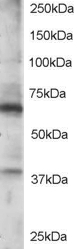
Images |
|
||
Specification |
|||
Quantity |
|
||
| Select | Brand | Catalog No. | Product Name | Pack Size | Type | Field of Research | Specification | Quantity | Price(USD) | |
| 1 | Leading Biology | APR03440G | ITGA11 Antibody (N-term) | 100 μl | Polyclonal Antibodies |
|
$495.00 | Add Ask | ||
| 2 | Leading Biology | APR04537G | CMIP Antibody (C-term) | 100 μl | Polyclonal Antibodies |
|
$495.00 | Add Ask | ||
| 3 | Leading Biology | APR12422G | Human H4 Histamine Receptor (extracellular) Antibody | 50 μl | Polyclonal Antibodies |
|
$695.00 | Add Ask | ||
| 4 | Leading Biology | APR04349G | HECTD2 Antibody (N-term) | 100 μl | Polyclonal Antibodies |
|
$495.00 | Add Ask | ||
| 5 | Leading Biology | APR03844G | UBE2W Antibody (C-term) | 100 μl | Polyclonal Antibodies |
|
$495.00 | Add Ask | ||
| 6 | Leading Biology | APR03502G | IGHG1 Antibody (Center) | 100 μl | Polyclonal Antibodies |
|
$495.00 | Add Ask |
Leading Biology Inc.
2600 Hilltop DR, Building G, B Suite C138
Richmond, CA, 94806
Tel: 1-661-524(LBI)-0262
Email: info@leadingbiology.com

You have 0 item in your cart
You have 0 item in your inquiry list