> Antigen, Antibodies, ELISA, Western Blot > Primary Antibody > Polyclonal Antibodies > ANGPT1 Antibody (CT)Brand |
Leading Biology | Catalog Number |
APG01876G |
Product Type |
Polyclonal Antibodies | Field of Research |
|
Product Overview |
We constantly strive to ensure we provide our customers with the best antibodies. As a result of this work we offer this antibody in purified format.
We are in the process of updating our datasheets. If you have any questions regarding this update, please feel free to contact our technical support team.
This product is a high quality ANGPT1 antibody (CT).
|
||
Molecular Weight |
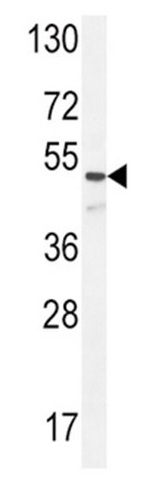
57513 Da
|
||
Cellular Localization |
Antigen Cellular Localization:
Secreted.
|
||
Host |
Rabbit
|
||
Species Reactivity |
Human, Mouse, Bovine
|
||
Target |
ANGPT1
|
||
Isotype |
Rabbit IgG
|
||
Symbol |
KIAA0003
|
||
GeneID |
|||
UniProt ID |
|||
Function |
Binds and activates TEK/TIE2 receptor by inducing its dimerization and tyrosine phosphorylation. Plays an important role in the regulation of angiogenesis, endothelial cell survival, proliferation, migration, adhesion and cell spreading, reorganization of the actin cytoskeleton, but also maintenance of vascular quiescence. Required for normal angiogenesis and heart development during embryogenesis. After birth, activates or inhibits angiogenesis, depending on the context. Inhibits angiogenesis and promotes vascular stability in quiescent vessels, where endothelial cells have tight contacts. In quiescent vessels, ANGPT1 oligomers recruit TEK to cell-cell contacts, forming complexes with TEK molecules from adjoining cells, and this leads to preferential activation of phosphatidylinositol 3-kinase and the AKT1 signaling cascades. In migrating endothelial cells that lack cell-cell adhesions, ANGT1 recruits TEK to contacts with the extracellular matrix, leading to the formation of focal adhesion complexes, activation of PTK2/FAK and of the downstream kinases MAPK1/ERK2 and MAPK3/ERK1, and ultimately to the stimulation of sprouting angiogenesis. Mediates blood vessel maturation/stability. Implicated in endothelial developmental processes later and distinct from that of VEGF. Appears to play a crucial role in mediating reciprocal interactions between the endothelium and surrounding matrix and mesenchyme.
|
||
Summary |
Angiopoietin-1 (Ang-1) is a secreted ligand for Tie-2, a tyrosine-kinase receptor expressed primarily on vascular endothelial cells and early hematopoietic cells. Ang-1/ Tie-2 signaling promotes angiogenesis during the development, remodeling, and repair of the vascular system. Transgenic mice lacking expression of either Ang-1 or Tie-2 fail to develop a fully functional cardiovascular system and die before birth. Postnatally, the angiogenic activity of Ang-1/Tie-2 is required during normal tissue repair and remodeling of the female endometrium in the menstrual cycle. Ang-1/Tie-2 signaling appears to be regulated by Angiopoietin-2 (Ang-2), a natural antagonist for Tie-2 that exerts its effects through an internal autocrine loop mechanism. In addition to suppressing endothelial cell activation by inhibiting the expression of adhesion and inflammatory molecules, Ang-1 enhances endothelial cell survival and capillary morphogenesis, and lessens capillary permeability. As such, Ang-1 has a potential to become an effective therapeutic agent for treating various endothelium disorders, including several severe human pulmonary diseases. The efficacy of cell-based Ang-1 gene therapy for acute lung injury (ALI) has recently been studied in a rat model of ALI. The results of this study show that such therapy can markedly improve lung condition and suggest that Ang-1 therapy may represent a potential new strategy for the treatment and/or prevention of acute respiratory distress injury (ARDI), a significant cause of morbidity and mortality in critically ill patients. Recombinant human ANG-1, derived from HeLa cells, is a C-terminal histidine tagged glycoprotein which migrates with an apparent molecular mass of 60.0 – 70.0 kDa by SDS-PAGE under reducing conditions. Sequencing analysis shows N-terminal sequences starting with Ser-20 and with Asp-70 of the 498 amino acid precursor protein.
|
||
Form |
Liquid. In PBS containing 0.02% sodium azide. |
||
Storage & Stability |
Store at +4°C short term. For long-term storage, aliquot and store at -20°C or below. Stable for 12 months at -20°C. Avoid repeated freeze-thaw cycles.
|
||
Applications |
WB
|
||
Synonyms |
ANGPT1; KIAA0003; Angiopoietin-1
|
||
Images |
|
||
Specification |
|||
Quantity |
|
||
| Select | Brand | Catalog No. | Product Name | Pack Size | Type | Field of Research | Specification | Quantity | Price(USD) | |
| 1 | Leading Biology | APR03440G | ITGA11 Antibody (N-term) | 100 μl | Polyclonal Antibodies |
|
$495.00 | Add Ask | ||
| 2 | Leading Biology | APR04537G | CMIP Antibody (C-term) | 100 μl | Polyclonal Antibodies |
|
$495.00 | Add Ask | ||
| 3 | Leading Biology | APR12422G | Human H4 Histamine Receptor (extracellular) Antibody | 50 μl | Polyclonal Antibodies |
|
$695.00 | Add Ask | ||
| 4 | Leading Biology | APR04349G | HECTD2 Antibody (N-term) | 100 μl | Polyclonal Antibodies |
|
$495.00 | Add Ask | ||
| 5 | Leading Biology | APR03844G | UBE2W Antibody (C-term) | 100 μl | Polyclonal Antibodies |
|
$495.00 | Add Ask | ||
| 6 | Leading Biology | APR03502G | IGHG1 Antibody (Center) | 100 μl | Polyclonal Antibodies |
|
$495.00 | Add Ask |
Leading Biology Inc.
2600 Hilltop DR, Building G, B Suite C138
Richmond, CA, 94806
Tel: 1-661-524(LBI)-0262
Email: info@leadingbiology.com

You have 0 item in your cart
You have 0 item in your inquiry list