> Antigen, Antibodies, ELISA, Western Blot > Primary Antibody > Polyclonal Antibodies > GPR41 AntibodyBrand |
Leading Biology | Catalog Number |
AMM05190G |
Product Type |
Polyclonal Antibodies | Field of Research |
|
Product Overview |
We constantly strive to ensure we provide our customers with the best antibodies. As a result of this work we offer this antibody in purified format.
We are in the process of updating our datasheets. If you have any questions regarding this update, please feel free to contact our technical support team.
This product is a high quality GPR41 antibody.
|
||
Molecular Weight |
39 KDa
|
||
Cellular Localization |
Antigen Cellular Localization:
Cell membrane; Multi-pass membrane protein
|
||
Host |
Rabbit
|
||
Species Reactivity |
Human, Mouse, Rat
|
||
Symbol |
GPR41
|
||
GeneID |
|||
UniProt ID |
|||
Function |
G protein-coupled receptor that is activated by a major product of dietary fiber digestion, the short chain fatty acids (SCFAs), and that plays a role in the regulation of whole-body energy homeostasis and in intestinal immunity. In omnivorous mammals, the short chain fatty acids acetate, propionate and butyrate are produced primarily by the gut microbiome that metabolizes dietary fibers. SCFAs serve as a source of energy but also act as signaling molecules. That G protein-coupled receptor is probably coupled to the pertussis toxin-sensitive, G(i/o)-alpha family of G proteins. Its activation results in the formation of inositol 1,4,5-trisphosphate, the mobilization of intracellular calcium, the phosphorylation of the MAPK3/ERK1 and MAPK1/ERK2 kinases and the inhibition of intracellular cAMP accumulation (PubMed:12711604). Activated by SCFAs and by beta-hydroxybutyrate, a ketone body produced by the liver upon starvation, it inhibits N-type calcium channels and modulates the activity of sympathetic neurons through a signaling cascade involving the beta and gamma subunits of its coupled G protein, phospholipase C and MAP kinases. Thereby, it may regulate energy expenditure through the control of the sympathetic nervous system that controls for instance heart rate. Upon activation by SCFAs accumulating in the intestine, it may also signal to the brain via neural circuits which in turn would regulate intestinal gluconeogenesis. May also control the production of hormones involved in whole-body energy homeostasis. May for instance, regulate blood pressure through renin secretion. May also regulate secretion of the PYY peptide by enteroendocrine cells and control gut motility, intestinal transit rate, and the harvesting of energy from SCFAs produced by gut microbiota. May also indirectly regulate the production of LEP/Leptin, a hormone acting on the CNS to inhibit food intake, in response to the presence of short-chain fatty acids in the intestine. Finally, may also play a role in glucose homeostasis. Besides its role in energy homeostasis, may play a role in intestinal immunity. May mediate the activation of the inflammatory and immune response by SCFAs in the gut, regulating the rapid production of chemokines and cytokines by intestinal epithelial cells. Among SCFAs, the fatty acids containing less than 6 carbons, the most potent activators are probably propionate, butyrate and pentanoate while acetate is a poor activator (PubMed:12496283, PubMed:12711604).
|
||
Summary |
Receptor for short chain fatty acids. The activity of this receptor is coupled to the formation of inositol 1,4,5- trisphosphate, intracellular Ca2+ mobilization, the activation of ERK 1/2 and inhibition of intracellular cAMP accumulation. Coupled exclusively to the pertussis toxin-sensitive G(i/o)-alpha protein. The rank order of potency for agonists of this receptor is propionate = pentanoate = butyrate > acetate > formate.
|
||
Form |
0.01M PBS, pH 7.2, 0.1% Sodium azide, Glycerol 50% |
||
Storage & Stability |
Store at +4°C short term. For long-term storage, aliquot and store at -20°C or below. Stable for 12 months at -20°C. Avoid repeated freeze-thaw cycles.
|
||
Applications |
WB
|
||
Dilution |
WB~~ 1:1000
|
||
Synonyms |
Free fatty acid receptor 3, G-protein coupled receptor 41, FFAR3, GPR41
|
||
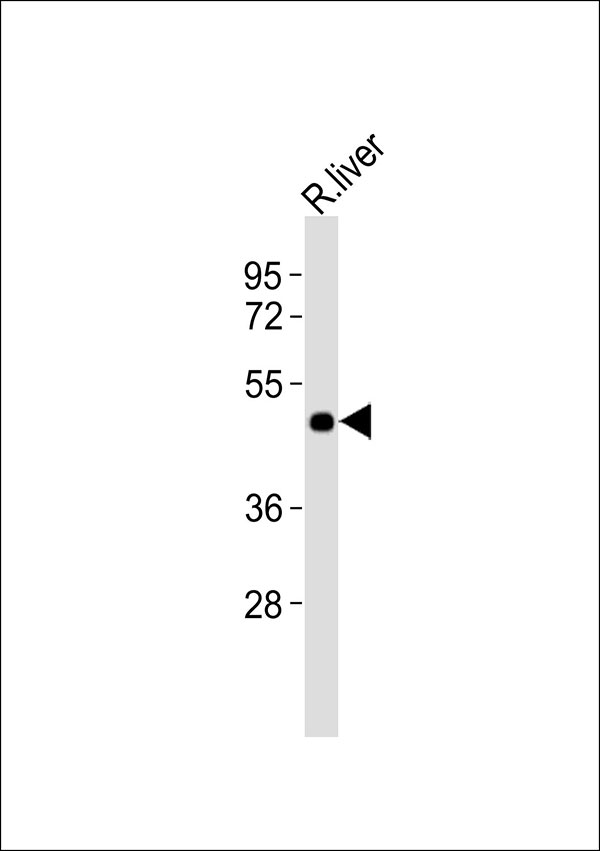
Images |
|
||
Specification |
|||
Quantity |
|
||
| Select | Brand | Catalog No. | Product Name | Pack Size | Type | Field of Research | Specification | Quantity | Price(USD) | |
| 1 | Leading Biology | APR03440G | ITGA11 Antibody (N-term) | 100 μl | Polyclonal Antibodies |
|
$495.00 | Add Ask | ||
| 2 | Leading Biology | APR04537G | CMIP Antibody (C-term) | 100 μl | Polyclonal Antibodies |
|
$495.00 | Add Ask | ||
| 3 | Leading Biology | APR12422G | Human H4 Histamine Receptor (extracellular) Antibody | 50 μl | Polyclonal Antibodies |
|
$695.00 | Add Ask | ||
| 4 | Leading Biology | APR04349G | HECTD2 Antibody (N-term) | 100 μl | Polyclonal Antibodies |
|
$495.00 | Add Ask | ||
| 5 | Leading Biology | APR03844G | UBE2W Antibody (C-term) | 100 μl | Polyclonal Antibodies |
|
$495.00 | Add Ask | ||
| 6 | Leading Biology | APR03502G | IGHG1 Antibody (Center) | 100 μl | Polyclonal Antibodies |
|
$495.00 | Add Ask |
Leading Biology Inc.
2600 Hilltop DR, Building G, B Suite C138
Richmond, CA, 94806
Tel: 1-661-524(LBI)-0262
Email: info@leadingbiology.com

You have 0 item in your cart
You have 0 item in your inquiry list