> Antigen, Antibodies, ELISA, Western Blot > Primary Antibody > Polyclonal Antibodies > SUV39H1 AntibodyBrand |
Leading Biology | Catalog Number |
APR11249G |
Product Type |
Polyclonal Antibodies | Field of Research |
|
Product Overview |
We constantly strive to ensure we provide our customers with the best antibodies. As a result of this work we offer this antibody in purified format.
We are in the process of updating our datasheets. If you have any questions regarding this update, please feel free to contact our technical support team.
This product is a high quality SUV39H1 antibody.
|
||
Molecular Weight |
47907 Da
|
||
Cellular Localization |
Antigen Cellular Localization:
Nucleus. Nucleus lamina. Nucleus, nucleoplasm. Chromosome, centromere. Note=Associates with centromeric constitutive heterochromatin
|
||
Host |
Rabbit
|
||
Species Reactivity |
Human, Mouse
|
||
Target |
Purified recombinant GST fusion protein encoding N-terminal of human SUV39H1.
|
||
Isotype |
Rabbit Ig
|
||
Symbol |
KMT1A, SUV39H
|
||
GeneID |
|||
UniProt ID |
|||
Function |
Histone methyltransferase that specifically trimethylates 'Lys-9' of histone H3 using monomethylated H3 'Lys- 9' as substrate. Also weakly methylates histone H1 (in vitro). H3 'Lys-9' trimethylation represents a specific tag for epigenetic transcriptional repression by recruiting HP1 (CBX1, CBX3 and/or CBX5) proteins to methylated histones. Mainly functions in heterochromatin regions, thereby playing a central role in the establishment of constitutive heterochromatin at pericentric and telomere regions. H3 'Lys-9' trimethylation is also required to direct DNA methylation at pericentric repeats. SUV39H1 is targeted to histone H3 via its interaction with RB1 and is involved in many processes, such as repression of MYOD1-stimulated differentiation, regulation of the control switch for exiting the cell cycle and entering differentiation, repression by the PML-RARA fusion protein, BMP-induced repression, repression of switch recombination to IgA and regulation of telomere length. Component of the eNoSC (energy-dependent nucleolar silencing) complex, a complex that mediates silencing of rDNA in response to intracellular energy status and acts by recruiting histone- modifying enzymes. The eNoSC complex is able to sense the energy status of cell: upon glucose starvation, elevation of NAD(+)/NADP(+) ratio activates SIRT1, leading to histone H3 deacetylation followed by dimethylation of H3 at 'Lys-9' (H3K9me2) by SUV39H1 and the formation of silent chromatin in the rDNA locus. Recruited by the large PER complex to the E-box elements of the circadian target genes such as PER2 itself or PER1, contributes to the conversion of local chromatin to a heterochromatin-like repressive state through H3 'Lys-9' trimethylation.
|
||
Summary |
Similar to acetylation and phosphorylation, histone methylation at the N-terminal tail has emerged as an important role in regulating chromatin dynamics and gene activity. Histone methylation occurs on arginine and lysine residues and is catalyzed by two families of proteins, the protein arginine methyltransferase family and the SET-domain-containing methyltransferase family. Five members have been identified in the arginine methyltransferase family. About 27 are grouped into the SET-domain family, and another 17 make up the PR domain family that is related to the SET domain family. The retinoblastoma protein-interacting zinc finger geneRIZ1 is a tumor suppressor gene and a FOUNDING member of the PR domain family. RIZ1 inactivation is commonly found in many types of human cancers and occurs through loss of mRNA expression, frame shift mutation, chromosomal deletion, and missense mutation. RIZ1 is also a tumor susceptibility gene in mice. The loss of RIZ1 mRNA in human cancers was shown to associate with DNA methylation of its promoter CpG island. Methylation of the RIZ1 promoter strongly correlated with lost or decreased RIZ1 mRNA expression in breast, liver, colon, and lung cancer cell lines as well as in liver cancer tissues.
|
||
Form |
Purified polyclonal antibody supplied in PBS with 0.09% (W/V) sodium azide. This antibody is prepared by Saturated Ammonium Sulfate (SAS) precipitation followed by dialysis against PBS. |
||
Storage & Stability |
Store at +4°C short term. For long-term storage, aliquot and store at -20°C or below. Stable for 12 months at -20°C. Avoid repeated freeze-thaw cycles.
|
||
Applications |
WB, E
|
||
Dilution |
WB~~1:1000
|
||
Synonyms |
Histone-lysine N-methyltransferase SUV39H1, Histone H3-K9 methyltransferase 1, H3-K9-HMTase 1, Lysine N-methyltransferase 1A, Position-effect variegation 3-9 homolog, Suppressor of variegation 3-9 homolog 1, Su(var)3-9 homolog 1, SUV39H1, KMT1A, SUV39H
|
||
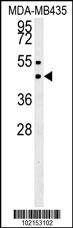
Images |
|
||
Specification |
|||
Quantity |
|
||
| Select | Brand | Catalog No. | Product Name | Pack Size | Type | Field of Research | Specification | Quantity | Price(USD) | |
| 1 | Leading Biology | APR03440G | ITGA11 Antibody (N-term) | 100 μl | Polyclonal Antibodies |
|
$495.00 | Add Ask | ||
| 2 | Leading Biology | APR04537G | CMIP Antibody (C-term) | 100 μl | Polyclonal Antibodies |
|
$495.00 | Add Ask | ||
| 3 | Leading Biology | APR12422G | Human H4 Histamine Receptor (extracellular) Antibody | 50 μl | Polyclonal Antibodies |
|
$695.00 | Add Ask | ||
| 4 | Leading Biology | APR04349G | HECTD2 Antibody (N-term) | 100 μl | Polyclonal Antibodies |
|
$495.00 | Add Ask | ||
| 5 | Leading Biology | APR03844G | UBE2W Antibody (C-term) | 100 μl | Polyclonal Antibodies |
|
$495.00 | Add Ask | ||
| 6 | Leading Biology | APR03502G | IGHG1 Antibody (Center) | 100 μl | Polyclonal Antibodies |
|
$495.00 | Add Ask |
Leading Biology Inc.
2600 Hilltop DR, Building G, B Suite C138
Richmond, CA, 94806
Tel: 1-661-524(LBI)-0262
Email: info@leadingbiology.com

You have 0 item in your cart
You have 0 item in your inquiry list