> Antigen, Antibodies, ELISA, Western Blot > Primary Antibody > Polyclonal Antibodies > DDX3 AntibodyBrand |
Leading Biology | Catalog Number |
APR06396G |
Product Type |
Polyclonal Antibodies | Field of Research |
|
Product Overview |
We constantly strive to ensure we provide our customers with the best antibodies. As a result of this work we offer this antibody in purified format.
We are in the process of updating our datasheets. If you have any questions regarding this update, please feel free to contact our technical support team.
This product is a high quality DDX3 Antibody.
|
||
Molecular Weight |
73243 Da
|
||
Cellular Localization |
Antigen Cellular Localization:
Nucleus speckle. Cytoplasm. Mitochondrion outer membrane. Note=Located predominantly in nuclear speckles and, at low levels, throughout the cytoplasm. Located to the outer side of nuclear pore complexes (NPC). Shuttles between the nucleus and the cytoplasm in a XPO1 and may be also in a NFX1-dependent manner. Associated with polyadenylated mRNAs in the cytoplasm and the nucleus. Predominantly located in nucleus during G(0) phase and in the cytoplasm during G1/S phase
|
||
Host |
Rabbit
|
||
Species Reactivity |
Human, Mouse
|
||
Target |
DDX3X; DDX3 antibody will detect both DDX3 and DBY.
|
||
Isotype |
IgG
|
||
Symbol |
DBX, DDX3
|
||
GeneID |
|||
UniProt ID |
|||
Function |
Multifunctional ATP-dependent RNA helicase. The ATPase activity can be stimulated by various ribo- and deoxynucleic acids indicative for a relaxed substrate specificity. In vitro can unwind partially double-stranded DNA with a preference for 5'- single-stranded DNA overhangs. Is involved in several steps of gene expression, such as transcription, mRNA maturation, mRNA export and translation. However, the exact mechanisms are not known and some functions may be specific for a subset of mRNAs. Involved in transcriptional regulation. Can enhance transcription from the CDKN1A/WAF1 promoter in a SP1-dependent manner. Found associated with the E-cadherin promoter and can down-regulate transcription from the promoter. Involved in regulation of translation initiation. Proposed to be involved in positive regulation of translation such as of cyclin E1/CCNE1 mRNA and specifically of mRNAs containing complex secondary structures in their 5'UTRs; these functions seem to require RNA helicase activity. Specifically promotes translation of a subset of viral and cellular mRNAs carrying a 5'proximal stem-loop structure in their 5'UTRs and cooperates with the eIF4F complex. Proposed to act prior to 43S ribosomal scanning and to locally destabilize these RNA structures to allow recognition of the mRNA cap or loading onto the 40S subunit. After association with 40S ribosomal subunits seems to be involved in the functional assembly of 80S ribosomes; the function seems to cover translation of mRNAs with structured and non-structured 5'UTRs and is independent of RNA helicase activity. Also proposed to inhibit cap-dependent translation by competetive interaction with EIF4E which can block the EIF4E:EIF4G complex formation. Proposed to be involved in stress response and stress granule assembly; the function is independent of RNA helicase activity and seems to involve association with EIF4E. May be involved in nuclear export of specific mRNAs but not in bulk mRNA export via interactions with XPO1 and NXF1. Also associates with polyadenylated mRNAs independently of NXF1. Associates with spliced mRNAs in an exon junction complex (EJC)-dependent manner and seems not to be directly involved in splicing. May be involved in nuclear mRNA export by association with DDX5 and regulating its nuclear location. Involved in innate immune signaling promoting the production of type I interferon (IFN-alpha and IFN-beta); proposed to act as viral RNA sensor, signaling intermediate and transcriptional coactivator. Involved in TBK1 and IKBKE-dependent IRF3 activation leading to IFNB induction, plays a role of scaffolding adapter that links IKBKE and IRF3 and coordinates their activation. Also found associated with IFNB promoters; the function is independent of IRF3. Can bind to viral RNAs and via association with MAVS/IPS1 and DDX58/RIG-I is thought to induce signaling in early stages of infection. Involved in regulation of apoptosis. May be required for activation of the intrinsic but inhibit activation of the extrinsic apoptotic pathway. Acts as an antiapoptotic protein through association with GSK3A/B and BIRC2 in an apoptosis antagonizing signaling complex; activation of death receptors promotes caspase-dependent cleavage of BIRC2 and DDX3X and relieves the inhibition. May be involved in mitotic chromosome segregation. Appears to be a prime target for viral manipulations. Hepatitis B virus (HBV) polymerase and possibly vaccinia virus (VACV) protein K7 inhibit IFNB induction probably by dissociating DDX3X from TBK1 or IKBKE. Is involved in hepatitis C virus (HCV) replication; the function may involve the association with HCV core protein. HCV core protein inhibits the IPS1-dependent function in viral RNA sensing and may switch the function from a INFB inducing to a HCV replication mode. Involved in HIV-1 replication. Acts as a cofactor for XPO1-mediated nuclear export of incompletely spliced HIV-1 Rev RNAs.
|
||
Summary |
DDX3 Antibody: DDX3 contains all of the motifs of the DEAD-box family of RNA helicases, including the Asp-Glu-Ala-Asp sequence that gives the protein family its name and distinguishes it from other RNA helicases. DDX3 is localized to the X chromosome and has a highly conserved functional homolog (DBY) on the Y chromosome. DDX3 is thought to be involved in RNA splicing, RNA transport, and translation initiation. It has also been shown to be involved in cell growth control and is deregulated in hepatitis virus-associated hepatocellular carcinoma. Recent experiments suppressing DDX3 expression blocked HIV-1 RNA export from the nucleus, suggesting that DDX3 functions as a shuttling protein that transports the HIV-1 protein Rev and its cofactor CRM1 from the nucleus to the cytoplasm.
|
||
Storage & Stability |
Store at +4°C short term. For long-term storage, aliquot and store at -20°C or below. Stable for 12 months at -20°C. Avoid repeated freeze-thaw cycles.
|
||
Applications |
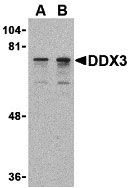
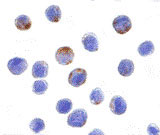
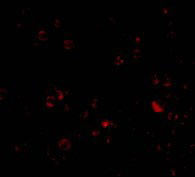
WB, IF, ICC, E
|
||
Images |
|
||
Specification |
|||
Quantity |
|
||
| Select | Brand | Catalog No. | Product Name | Pack Size | Type | Field of Research | Specification | Quantity | Price(USD) | |
| 1 | Leading Biology | APR03440G | ITGA11 Antibody (N-term) | 100 μl | Polyclonal Antibodies |
|
$495.00 | Add Ask | ||
| 2 | Leading Biology | APR04537G | CMIP Antibody (C-term) | 100 μl | Polyclonal Antibodies |
|
$495.00 | Add Ask | ||
| 3 | Leading Biology | APR12422G | Human H4 Histamine Receptor (extracellular) Antibody | 50 μl | Polyclonal Antibodies |
|
$695.00 | Add Ask | ||
| 4 | Leading Biology | APR03844G | UBE2W Antibody (C-term) | 100 μl | Polyclonal Antibodies |
|
$495.00 | Add Ask | ||
| 5 | Leading Biology | APR04349G | HECTD2 Antibody (N-term) | 100 μl | Polyclonal Antibodies |
|
$495.00 | Add Ask | ||
| 6 | Leading Biology | APR03502G | IGHG1 Antibody (Center) | 100 μl | Polyclonal Antibodies |
|
$495.00 | Add Ask |
Leading Biology Inc.
2600 Hilltop DR, Building G, B Suite C138
Richmond, CA, 94806
Tel: 1-661-524(LBI)-0262
Email: info@leadingbiology.com

You have 0 item in your cart
You have 0 item in your inquiry list