> Antigen, Antibodies, ELISA, Western Blot > Primary Antibody > Polyclonal Antibodies > IL27 Antibody (Internal)Brand |
Leading Biology | Catalog Number |
APR02523G |
Product Type |
Polyclonal Antibodies | Field of Research |
|
Product Overview |
We constantly strive to ensure we provide our customers with the best antibodies. As a result of this work we offer this antibody in purified format.
We are in the process of updating our datasheets. If you have any questions regarding this update, please feel free to contact our technical support team.
This product is a high quality IL27 Antibody (Internal).
|
||
Molecular Weight |
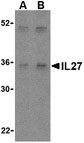
27kDa
|
||
Cellular Localization |
Antigen Cellular Localization:
Secreted. Note=Does not seem to be secreted without coexpression of EBI3
|
||
Host |
Rabbit
|
||
Species Reactivity |
Human, Mouse
|
||
Target |
This antibody recognize IL27A (NP_663634).
|
||
Symbol |
IL27A, IL30
|
||
GeneID |
|||
UniProt ID |
|||
Function |
Associates with EBI3 to form the IL-27 interleukin, a heterodimeric cytokine which functions in innate immunity. IL-27 has pro- and anti-inflammatory properties, that can regulate T- helper cell development, suppress T-cell proliferation, stimulate cytotoxic T-cell activity, induce isotype switching in B-cells, and that has diverse effects on innate immune cells. Among its target cells are CD4 T-helper cells which can differentiate in type 1 effector cells (TH1), type 2 effector cells (TH2) and IL17 producing helper T-cells (TH17). It drives rapid clonal expansion of naive but not memory CD4 T-cells. It also strongly synergizes with IL-12 to trigger interferon-gamma/IFN-gamma production of naive CD4 T-cells, binds to the cytokine receptor WSX-1/TCCR which appears to be required but not sufficient for IL-27-mediated signal transduction. IL-27 potentiate the early phase of TH1 response and suppress TH2 and TH17 differentiation. It induces the differentiation of TH1 cells via two distinct pathways, p38 MAPK/TBX21- and ICAM1/ITGAL/ERK-dependent pathways. It also induces STAT1, STAT3, STAT4 and STAT5 phosphorylation and activates TBX21/T-Bet via STAT1 with resulting IL12RB2 up- regulation, an event crucial to TH1 cell commitment. It suppresses the expression of GATA3, the inhibitor TH1 cells development. In CD8 T-cells, it activates STATs as well as GZMB. IL-27 reveals to be a potent inhibitor of TH17 cell development and of IL-17 production. Indeed IL27 alone is also able to inhibit the production of IL17 by CD4 and CD8 T-cells. While IL-27 suppressed the development of proinflammatory Th17 cells via STAT1, it inhibits the development of anti-inflammatory inducible regulatory T-cells, iTreg, independently of STAT1. IL-27 has also an effect on cytokine production, it suppresses proinflammatory cytokine production such as IL2, IL4, IL5 and IL6 and activates suppressors of cytokine signaling such as SOCS1 and SOCS3. Apart from suppression of cytokine production, IL-27 also antagonizes the effects of some cytokines such as IL6 through direct effects on T- cells. Another important role of IL-27 is its antitumor activity as well as its antiangiogenic activity with activation of production of antiangiogenic chemokines such as IP-10/CXCL10 and MIG/CXCL9. In vein endothelial cells, it induces IRF1/interferon regulatory factor 1 and increase the expression of MHC class II transactivator/CIITA with resulting up-regulation of major histocompatibility complex class II. IL-27 also demonstrates antiviral activity with inhibitory properties on HIV-1 replication.
|
||
Summary |
Associates with EBI3 to form the IL-27 interleukin, a heterodimeric cytokine which functions in innate immunity. IL-27 has pro- and anti-inflammatory properties, that can regulate T- helper cell development, suppress T-cell proliferation, stimulate cytotoxic T-cell activity, induce isotype switching in B-cells, and that has diverse effects on innate immune cells. Among its target cells are CD4 T-helper cells which can differentiate in type 1 effector cells (TH1), type 2 effector cells (TH2) and IL17 producing helper T-cells (TH17). It drives rapid clonal expansion of naive but not memory CD4 T-cells. It also strongly synergizes with IL-12 to trigger interferon-gamma/IFN-gamma production of naive CD4 T-cells, binds to the cytokine receptor WSX-1/TCCR which appears to be required but not sufficient for IL-27-mediated signal transduction. IL-27 potentiate the early phase of TH1 response and suppress TH2 and TH17 differentiation. It induces the differentiation of TH1 cells via two distinct pathways, p38 MAPK/TBX21- and ICAM1/ITGAL/ERK-dependent pathways. It also induces STAT1, STAT3, STAT4 and STAT5 phosphorylation and activates TBX21/T-Bet via STAT1 with resulting IL12RB2 up- regulation, an event crucial to TH1 cell commitment. It suppresses the expression of GATA3, the inhibitor TH1 cells development. In CD8 T-cells, it activates STATs as well as GZMB. IL-27 reveals to be a potent inhibitor of TH17 cell development and of IL-17 production. Indeed IL27 alone is also able to inhibit the production of IL17 by CD4 and CD8 T-cells. While IL-27 suppressed the development of proinflammatory Th17 cells via STAT1, it inhibits the development of anti-inflammatory inducible regulatory T-cells, iTreg, independently of STAT1. IL-27 has also an effect on cytokine production, it suppresses proinflammatory cytokine production such as IL2, IL4, IL5 and IL6 and activates suppressors of cytokine signaling such as SOCS1 and SOCS3. Apart from suppression of cytokine production, IL-27 also antagonizes the effects of some cytokines such as IL6 through direct effects on T- cells. Another important role of IL-27 is its antitumor activity as well as its antiangiogenic activity with activation of production of antiangiogenic chemokines such as IP-10/CXCL10 and MIG/CXCL9. In vein endothelial cells, it induces IRF1/interferon regulatory factor 1 and increase the expression of MHC class II transactivator/CIITA with resulting up-regulation of major histocompatibility complex class II. IL-27 also demonstrates antiviral activity with inhibitory properties on HIV-1 replication.
|
||
Storage & Stability |
Store at +4°C short term. For long-term storage, aliquot and store at -20°C or below. Stable for 12 months at -20°C. Avoid repeated freeze-thaw cycles.
|
||
Applications |
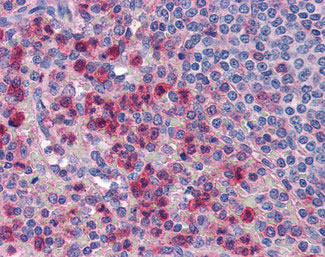
WB, IHC-P, E
|
||
Dilution |
IHC-P (5 μg/ml), WB (2-4 μg/ml),
|
||
Images |
|
||
Specification |
|||
Quantity |
|
||
| Select | Brand | Catalog No. | Product Name | Pack Size | Type | Field of Research | Specification | Quantity | Price(USD) | |
| 1 | Leading Biology | APR03440G | ITGA11 Antibody (N-term) | 100 μl | Polyclonal Antibodies |
|
$495.00 | Add Ask | ||
| 2 | Leading Biology | APR04537G | CMIP Antibody (C-term) | 100 μl | Polyclonal Antibodies |
|
$495.00 | Add Ask | ||
| 3 | Leading Biology | APR12422G | Human H4 Histamine Receptor (extracellular) Antibody | 50 μl | Polyclonal Antibodies |
|
$695.00 | Add Ask | ||
| 4 | Leading Biology | APR04349G | HECTD2 Antibody (N-term) | 100 μl | Polyclonal Antibodies |
|
$495.00 | Add Ask | ||
| 5 | Leading Biology | APR03844G | UBE2W Antibody (C-term) | 100 μl | Polyclonal Antibodies |
|
$495.00 | Add Ask | ||
| 6 | Leading Biology | APR03502G | IGHG1 Antibody (Center) | 100 μl | Polyclonal Antibodies |
|
$495.00 | Add Ask |
Leading Biology Inc.
2600 Hilltop DR, Building G, B Suite C138
Richmond, CA, 94806
Tel: 1-661-524(LBI)-0262
Email: info@leadingbiology.com

You have 0 item in your cart
You have 0 item in your inquiry list