> Antigen, Antibodies, ELISA, Western Blot > Primary Antibody > Polyclonal Antibodies > Ubiquilin1 Antibody (Center)Brand |
Leading Biology | Catalog Number |
APR04916G |
Product Type |
Polyclonal Antibodies | Field of Research |
|
Product Overview |
We constantly strive to ensure we provide our customers with the best antibodies. As a result of this work we offer this antibody in purified format.
We are in the process of updating our datasheets. If you have any questions regarding this update, please feel free to contact our technical support team.
This product is a high quality Ubiquilin1 Antibody (Center).
|
||
Molecular Weight |
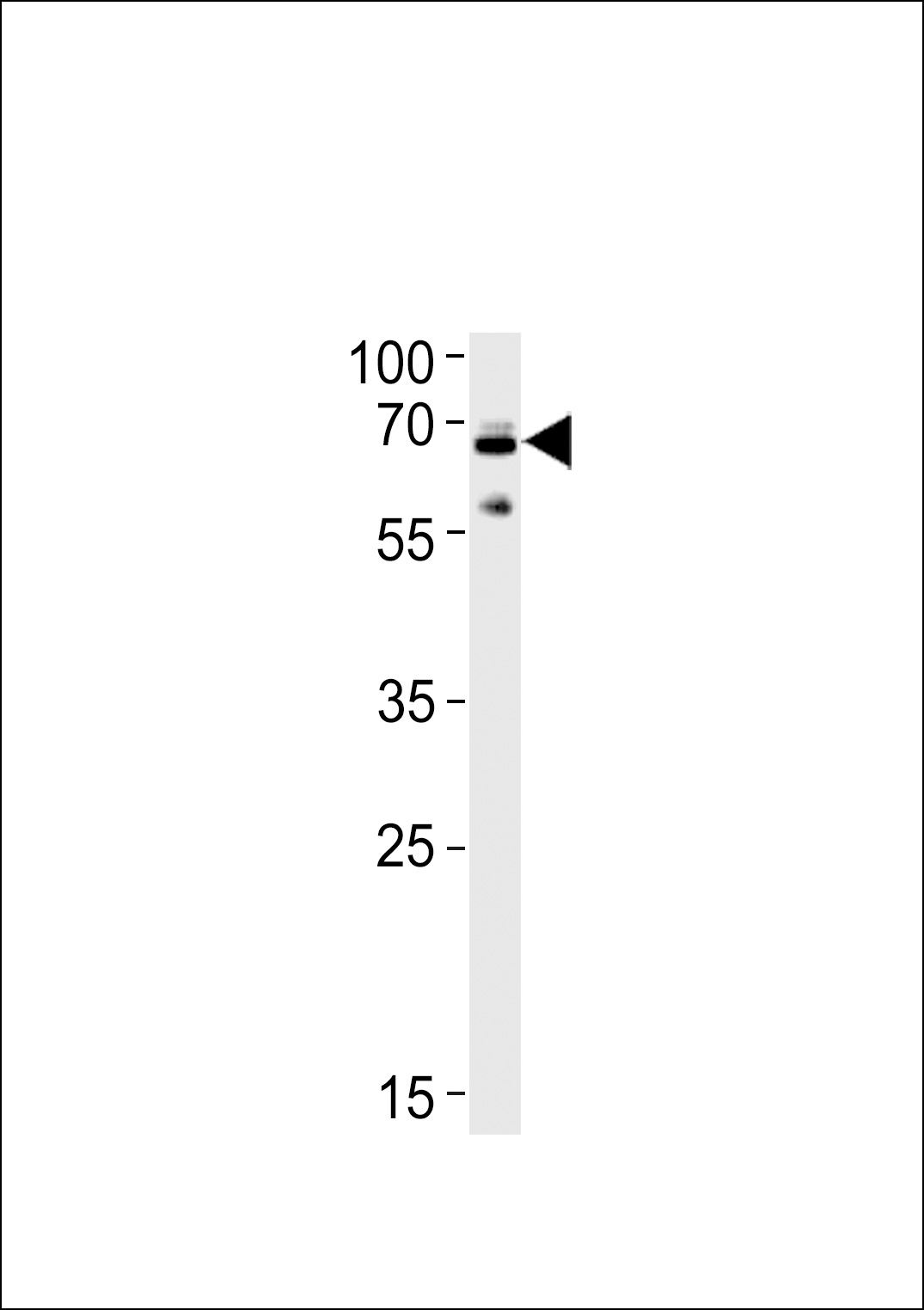
62519 Da
|
||
Cellular Localization |
Antigen Cellular Localization:
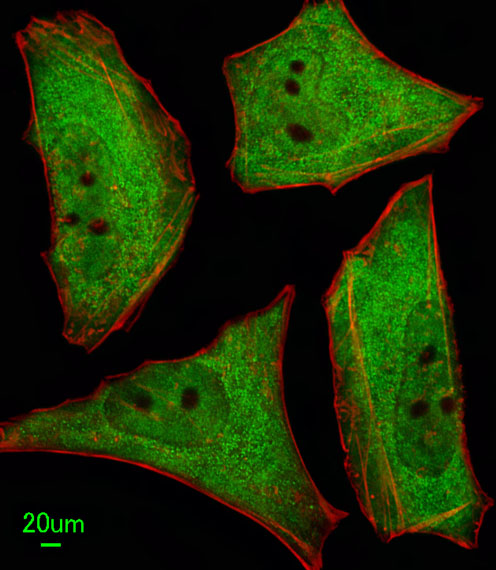
Cytoplasm. Nucleus. Note=Detected in neuronal processes and at synapses (By similarity). Detected in cytosolic puncta that may correspond to autophagosomes.
|
||
Host |
Rabbit
|
||
Species Reactivity |
Human, Mouse
|
||
Immunogen |
296-326 aa
|
||
Target |
This Ubiquilin1 antibody is generated from rabbits immunized with a KLH conjugated synthetic peptide between 296-326 amino acids from the Central region of human Ubiquilin1.
|
||
Isotype |
Rabbit Ig
|
||
Symbol |
DA41, PLIC1
|
||
GeneID |
|||
UniProt ID |
|||
Function |
Links CD47 to the cytoskeleton. Promotes the surface expression of GABA-A receptors. Promotes the accumulation of uncleaved PSEN1 and PSEN2 by stimulating their biosynthesis. Has no effect on PSEN1 and PSEN2 degradation.
|
||
Summary |
Ubiquilin 1 (UBQLN1), also known as DA41, was isolated from an adult rat lung cDNA library, and encodes a cellular protein that associates with DAN.1 DAN expression is reduced in rat fibroblast 3Y1 cells transformed with mouse sarcoma virus and in rodent fibroblasts transformed with a variety of oncogenes. The DAN-DA41 interaction is mediated through the N-terminal domain and a cysteine-knot region of DAN. Human DA41 encodes a 589-amino acid protein with 86% amino acid sequence identity with rat protein.2 DA41 expression is regulated in a cell cycle-dependent manner. PLIC1 and PLIC2 (UBQLN2) are homologs of the mouse Plics (proteins linking integrin-associated protein (IAP) and cytoskeleton) and the yeast Dsk2 protein. PLIC1, also called UBQLN1, shares 72% amino acid identity with PLIC2,3 Two motifs are conserved in the mammalian PLICs and yeast Dsk2, an N-terminal ubiquitin-like (UBL) domain and a C-terminal ubiquitin-associated (UBA) domain. Unlike ubiquitin, the UBL domain of the PLICs does not have a diglycine motif in its C terminus. The UBA domain is present in multiple enzyme classes of the ubiquitination machinery. Human PLICs associate with both proteasomes and ubiquitin ligases in large complexes. Overexpression of PLICs impairs the in vivo degradation of 2 unrelated ubiquitin-dependent proteasome substrates, p53 and I-kappa-B-alpha (NFKBIA), but not a ubiquitin-independent substrate. PLICs may link the ubiquitination machinery to the proteasome to affect in vivo protein degradation. The DA41 gene maps to chromosome 9q21.2-q21.3, a position overlapping a candidate tumor suppressor locus for bladder cancer.2
|
||
Storage & Stability |
Store at +4°C short term. For long-term storage, aliquot and store at -20°C or below. Stable for 12 months at -20°C. Avoid repeated freeze-thaw cycles.
|
||
Applications |
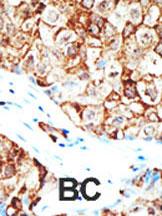
WB, IHC-P, IF, E
|
||
Dilution |
IF~~1:100
WB~~1:1000
IHC-P~~1:50~100
|
||
Images |
|
||
Specification |
|||
Quantity |
|
||
| Select | Brand | Catalog No. | Product Name | Pack Size | Type | Field of Research | Specification | Quantity | Price(USD) | |
| 1 | Leading Biology | APR03440G | ITGA11 Antibody (N-term) | 100 μl | Polyclonal Antibodies |
|
$495.00 | Add Ask | ||
| 2 | Leading Biology | APR04537G | CMIP Antibody (C-term) | 100 μl | Polyclonal Antibodies |
|
$495.00 | Add Ask | ||
| 3 | Leading Biology | APR12422G | Human H4 Histamine Receptor (extracellular) Antibody | 50 μl | Polyclonal Antibodies |
|
$695.00 | Add Ask | ||
| 4 | Leading Biology | APR04349G | HECTD2 Antibody (N-term) | 100 μl | Polyclonal Antibodies |
|
$495.00 | Add Ask | ||
| 5 | Leading Biology | APR03844G | UBE2W Antibody (C-term) | 100 μl | Polyclonal Antibodies |
|
$495.00 | Add Ask | ||
| 6 | Leading Biology | APR03502G | IGHG1 Antibody (Center) | 100 μl | Polyclonal Antibodies |
|
$495.00 | Add Ask |
Leading Biology Inc.
2600 Hilltop DR, Building G, B Suite C138
Richmond, CA, 94806
Tel: 1-661-524(LBI)-0262
Email: info@leadingbiology.com

You have 0 item in your cart
You have 0 item in your inquiry list