> Antigen, Antibodies, ELISA, Western Blot > Primary Antibody > Polyclonal Antibodies > AGL Antibody (N-term)Brand |
Leading Biology | Catalog Number |
APR05039G |
Product Type |
Polyclonal Antibodies | Field of Research |
|
Product Overview |
We constantly strive to ensure we provide our customers with the best antibodies. As a result of this work we offer this antibody in purified format.
We are in the process of updating our datasheets. If you have any questions regarding this update, please feel free to contact our technical support team.
This product is a high quality AGL Antibody (N-term).
|
||
Molecular Weight |
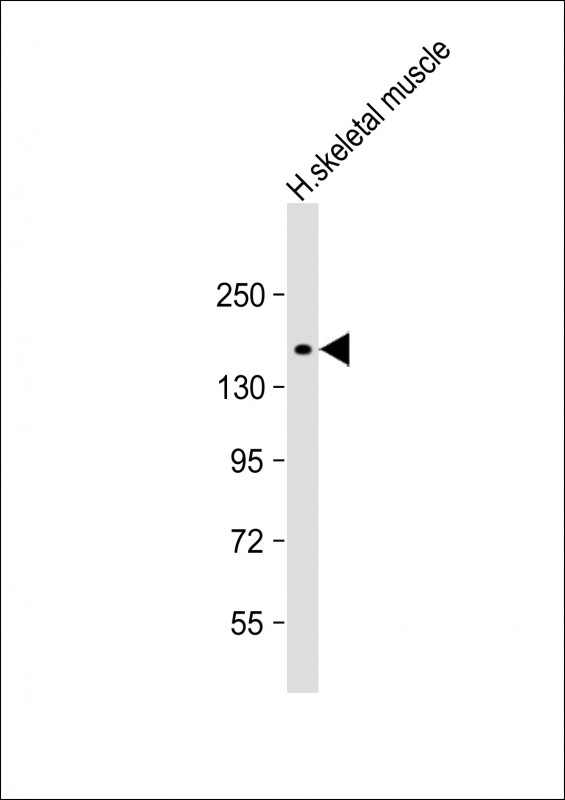
174764 Da
|
||
Cellular Localization |
Antigen Cellular Localization:
Cytoplasm. Note=Under glycogenolytic conditions localizes to the nucleus
|
||
Host |
Rabbit
|
||
Species Reactivity |
Human
|
||
Target |
This AGL antibody is generated from rabbits immunized with a KLH conjugated synthetic peptide selected from the N-terminal region of human AGL.
|
||
Isotype |
Rabbit Ig
|
||
Symbol |
GDE
|
||
GeneID |
|||
UniProt ID |
|||
Function |
Multifunctional enzyme acting as 1,4-alpha-D-glucan:1,4- alpha-D-glucan 4-alpha-D-glycosyltransferase and amylo-1,6- glucosidase in glycogen degradation.
|
||
Summary |
AGL is a glycogen debrancher enzyme which is involved in glycogen degradation. This enzyme has two independent catalytic activities which occur at different sites on the protein: a 4-alpha-glucotransferase activity and a amylo-1,6-glucosidase activity. Mutations in the AGL gene are associated with glycogen storage disease although a wide range of enzymatic and clinicalvariability occurs which may be due to tissue-specific alternative splicing.
|
||
Storage & Stability |
Store at +4°C short term. For long-term storage, aliquot and store at -20°C or below. Stable for 12 months at -20°C. Avoid repeated freeze-thaw cycles.
|
||
Applications |
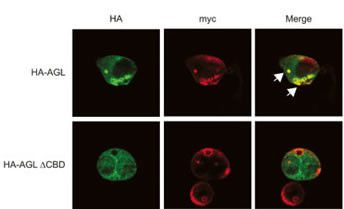
WB, IF, E
|
||
Dilution |
WB~~1:1000
IF~~1:10~50
|
||
Images |
|
||
Specification |
|||
Quantity |
|
||
| Select | Brand | Catalog No. | Product Name | Pack Size | Type | Field of Research | Specification | Quantity | Price(USD) | |
| 1 | Leading Biology | APR03440G | ITGA11 Antibody (N-term) | 100 μl | Polyclonal Antibodies |
|
$495.00 | Add Ask | ||
| 2 | Leading Biology | APR04537G | CMIP Antibody (C-term) | 100 μl | Polyclonal Antibodies |
|
$495.00 | Add Ask | ||
| 3 | Leading Biology | APR12422G | Human H4 Histamine Receptor (extracellular) Antibody | 50 μl | Polyclonal Antibodies |
|
$695.00 | Add Ask | ||
| 4 | Leading Biology | APR04349G | HECTD2 Antibody (N-term) | 100 μl | Polyclonal Antibodies |
|
$495.00 | Add Ask | ||
| 5 | Leading Biology | APR03844G | UBE2W Antibody (C-term) | 100 μl | Polyclonal Antibodies |
|
$495.00 | Add Ask | ||
| 6 | Leading Biology | APR03502G | IGHG1 Antibody (Center) | 100 μl | Polyclonal Antibodies |
|
$495.00 | Add Ask |
Leading Biology Inc.
2600 Hilltop DR, Building G, B Suite C138
Richmond, CA, 94806
Tel: 1-661-524(LBI)-0262
Email: info@leadingbiology.com

You have 0 item in your cart
You have 0 item in your inquiry list