> Antigen, Antibodies, ELISA, Western Blot > Primary Antibody > Polyclonal Antibodies > PSMC2 Antibody (N-term)Brand |
Leading Biology | Catalog Number |
APR03979G |
Product Type |
Polyclonal Antibodies | Field of Research |
|
Product Overview |
We constantly strive to ensure we provide our customers with the best antibodies. As a result of this work we offer this antibody in purified format.
We are in the process of updating our datasheets. If you have any questions regarding this update, please feel free to contact our technical support team.
This product is a high quality PSMC2 Antibody (N-term).
|
||
Molecular Weight |
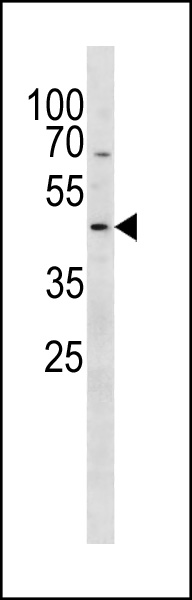
48634 Da
|
||
Cellular Localization |
Antigen Cellular Localization:
Cytoplasm. Nucleus. Cytoplasm, P-body. Note=Colocalizes with TRIM5 in the cytoplasmic bodies.
|
||
Host |
Rabbit
|
||
Species Reactivity |
Human
|
||
Immunogen |
1-30 aa
|
||
Target |
This PSMC2 antibody is generated from rabbits immunized with a KLH conjugated synthetic peptide between 1-30 amino acids from the N-terminal region of human PSMC2.
|
||
Isotype |
Rabbit Ig
|
||
Symbol |
MSS1
|
||
GeneID |
|||
UniProt ID |
|||
Function |
The 26S protease is involved in the ATP-dependent degradation of ubiquitinated proteins. The regulatory (or ATPase) complex confers ATP dependency and substrate specificity to the 26S complex. In case of HIV-1 infection, positive modulator of Tat-mediated transactivation.
|
||
Summary |
The 26S proteasome is a multicatalytic proteinase complexwith a highly ordered structure composed of 2 complexes, a 20S coreand a 19S regulator. The 20S core is composed of 4 rings of 28non-identical subunits; 2 rings are composed of 7 alpha subunitsand 2 rings are composed of 7 beta subunits. The 19S regulator iscomposed of a base, which contains 6 ATPase subunits and 2non-ATPase subunits, and a lid, which contains up to 10 non-ATPasesubunits. Proteasomes are distributed throughout eukaryotic cellsat a high concentration and cleave peptides in anATP/ubiquitin-dependent process in a non-lysosomal pathway. Anessential function of a modified proteasome, the immunoproteasome,is the processing of class I MHC peptides. This gene encodes one ofthe ATPase subunits, a member of the triple-A family of ATPaseswhich have a chaperone-like activity. This subunit has been shownto interact with several of the basal transcription factors so, inaddition to participation in proteasome functions, this subunit mayparticipate in the regulation of transcription. This subunit mayalso compete with PSMC3 for binding to the HIV tat protein toregulate the interaction between the viral protein and thetranscription complex.
|
||
Storage & Stability |
Store at +4°C short term. For long-term storage, aliquot and store at -20°C or below. Stable for 12 months at -20°C. Avoid repeated freeze-thaw cycles.
|
||
Applications |
WB, E
|
||
Dilution |
WB~~1:1000
|
||
Images |
|
||
Specification |
|||
Quantity |
|
||
| Select | Brand | Catalog No. | Product Name | Pack Size | Type | Field of Research | Specification | Quantity | Price(USD) | |
| 1 | Leading Biology | APR03440G | ITGA11 Antibody (N-term) | 100 μl | Polyclonal Antibodies |
|
$495.00 | Add Ask | ||
| 2 | Leading Biology | APR04537G | CMIP Antibody (C-term) | 100 μl | Polyclonal Antibodies |
|
$495.00 | Add Ask | ||
| 3 | Leading Biology | APR12422G | Human H4 Histamine Receptor (extracellular) Antibody | 50 μl | Polyclonal Antibodies |
|
$695.00 | Add Ask | ||
| 4 | Leading Biology | APR04349G | HECTD2 Antibody (N-term) | 100 μl | Polyclonal Antibodies |
|
$495.00 | Add Ask | ||
| 5 | Leading Biology | APR03844G | UBE2W Antibody (C-term) | 100 μl | Polyclonal Antibodies |
|
$495.00 | Add Ask | ||
| 6 | Leading Biology | APR03502G | IGHG1 Antibody (Center) | 100 μl | Polyclonal Antibodies |
|
$495.00 | Add Ask |
Leading Biology Inc.
2600 Hilltop DR, Building G, B Suite C138
Richmond, CA, 94806
Tel: 1-661-524(LBI)-0262
Email: info@leadingbiology.com

You have 0 item in your cart
You have 0 item in your inquiry list