> Antigen, Antibodies, ELISA, Western Blot > Primary Antibody > Polyclonal Antibodies > CTTN Antibody (Center)Brand |
Leading Biology | Catalog Number |
APR03855G |
Product Type |
Polyclonal Antibodies | Field of Research |
|
Product Overview |
We constantly strive to ensure we provide our customers with the best antibodies. As a result of this work we offer this antibody in purified format.
We are in the process of updating our datasheets. If you have any questions regarding this update, please feel free to contact our technical support team.
This product is a high quality CTTN Antibody (Center).
|
||
Molecular Weight |
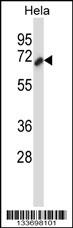
61586 Da
|
||
Cellular Localization |
Antigen Cellular Localization:
Cytoplasm, cytoskeleton. Cell projection, lamellipodium. Cell projection, ruffle. Cell projection, dendrite. Cell projection {ECO:0000250|UniProtKB:Q66HL2}. Cell membrane; Peripheral membrane protein; Cytoplasmic side. Cell projection, podosome {ECO:0000250|UniProtKB:Q01406}. Cell junction {ECO:0000250|UniProtKB:Q66HL2}. Cell junction, focal adhesion {ECO:0000250|UniProtKB:Q66HL2}. Membrane, clathrin-coated pit {ECO:0000250|UniProtKB:Q66HL2}. Cell projection, dendritic spine. Cytoplasm, cell cortex. Note=Colocalizes transiently with PTK2/FAK1 at focal adhesions (By similarity). Associated with membrane ruffles and lamellipodia. In the presence of CTTNBP2NL, colocalizes with stress fibers (By similarity). In the presence of CTTNBP2, localizes at the cell cortex (By similarity). In response to neuronal activation by glutamate, redistributes from dendritic spines to the dendritic shaft (By similarity). Colocalizes with DNM2 at the basis of filopodia in hippocampus neuron growth zones (By similarity). {ECO:0000250|UniProtKB:Q60598, ECO:0000250|UniProtKB:Q66HL2}
|
||
Host |
Rabbit
|
||
Species Reactivity |
Human
|
||
Immunogen |
273-302 aa
|
||
Target |
This CTTN antibody is generated from rabbits immunized with a KLH conjugated synthetic peptide between 273-302 amino acids from the Central region of human CTTN.
|
||
Isotype |
Rabbit Ig
|
||
Symbol |
EMS1
|
||
GeneID |
|||
UniProt ID |
|||
Function |
Contributes to the organization of the actin cytoskeleton and cell shape (PubMed:21296879). Plays a role in the formation of lamellipodia and in cell migration. Plays a role in the regulation of neuron morphology, axon growth and formation of neuronal growth cones (By similarity). Through its interaction with CTTNBP2, involved in the regulation of neuronal spine density (By similarity). Plays a role in the invasiveness of cancer cells, and the formation of metastases (PubMed:16636290). Plays a role in focal adhesion assembly and turnover (By similarity). In complex with ABL1 and MYLK regulates cortical actin-based cytoskeletal rearrangement critical to sphingosine 1-phosphate (S1P)-mediated endothelial cell (EC) barrier enhancement (PubMed:20861316). Plays a role in intracellular protein transport and endocytosis, and in modulating the levels of potassium channels present at the cell membrane (PubMed:17959782). Plays a role in receptor-mediated endocytosis via clathrin-coated pits (By similarity).
|
||
Summary |
This gene is overexpressed in breast cancer and squamouscell carcinomas of the head and neck. The encoded protein islocalized in the cytoplasm and in areas of the cell-substratumcontacts. This gene has two roles: (1) regulating the interactionsbetween components of adherens-type junctions and (2) organizingthe cytoskeleton and cell adhesion structures of epithelia andcarcinoma cells. During apoptosis, the encoded protein is degradedin a caspase-dependent manner. The aberrant regulation of this genecontributes to tumor cell invasion and metastasis. Three splicevariants that encode different isoforms have been identified forthis gene.
|
||
Storage & Stability |
Store at +4°C short term. For long-term storage, aliquot and store at -20°C or below. Stable for 12 months at -20°C. Avoid repeated freeze-thaw cycles.
|
||
Applications |
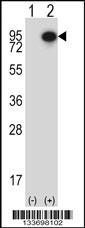
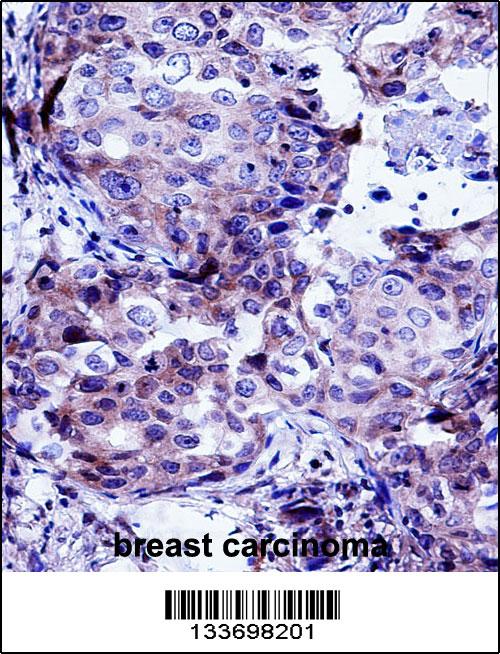
WB, IHC-P, E
|
||
Dilution |
WB~~1:1000
IHC-P~~1:10~50
|
||
Images |
|
||
Specification |
|||
Quantity |
|
||
| Select | Brand | Catalog No. | Product Name | Pack Size | Type | Field of Research | Specification | Quantity | Price(USD) | |
| 1 | Leading Biology | APR03440G | ITGA11 Antibody (N-term) | 100 μl | Polyclonal Antibodies |
|
$495.00 | Add Ask | ||
| 2 | Leading Biology | APR04537G | CMIP Antibody (C-term) | 100 μl | Polyclonal Antibodies |
|
$495.00 | Add Ask | ||
| 3 | Leading Biology | APR12422G | Human H4 Histamine Receptor (extracellular) Antibody | 50 μl | Polyclonal Antibodies |
|
$695.00 | Add Ask | ||
| 4 | Leading Biology | APR03844G | UBE2W Antibody (C-term) | 100 μl | Polyclonal Antibodies |
|
$495.00 | Add Ask | ||
| 5 | Leading Biology | APR04349G | HECTD2 Antibody (N-term) | 100 μl | Polyclonal Antibodies |
|
$495.00 | Add Ask | ||
| 6 | Leading Biology | APR03502G | IGHG1 Antibody (Center) | 100 μl | Polyclonal Antibodies |
|
$495.00 | Add Ask |
Leading Biology Inc.
2600 Hilltop DR, Building G, B Suite C138
Richmond, CA, 94806
Tel: 1-661-524(LBI)-0262
Email: info@leadingbiology.com

You have 0 item in your cart
You have 0 item in your inquiry list