


Introduction
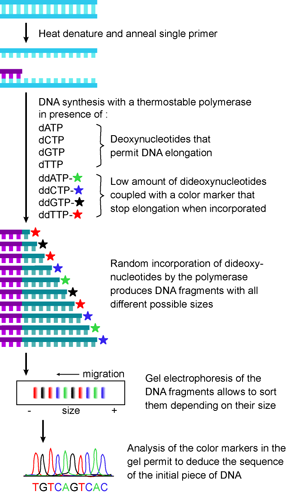
Specific DNA segments defined by the sequence of two oligonucleotides can be enzymatically amplified up to a millionfold using the polymerase chain reaction (PCR). One of the most significant uses of this technique is for the generation of sequencing templates, either from cloned inserts or directly from genomic DNA. To avoid the problem of reassociation of the linear DNA strands in the sequencing reaction, ssDNA templates can be produced directly in the PCR or generated directly from dsDNA by enzymatic treatment, electrophoretic separation or affinity purification. By combining PCR with direct sequencing, both the amplification and the sequencing reaction can be performed in the same vial. Finally, the use of fluorescently labeled terminators or sequencing primers will allow the whole procedure to be amenable to complete automation.
One of the main advantages of sequencing a PCR product directly is that you will not see PCR-generated mutations. The reason for this is that you have a large population of templates in your initial PCR reaction and even a mutation introduced in one PCR product in the first round of amplification will only be present in that one product out of thousands produced by the reaction. This very low frequency means that this error is swamped out by the majority (correct) sequence and so is not seen. As the reaction proceeds, the error is propagated, but so is the proportion of correct sequence at the same place in other templates.
| No | Headline | Click | Author | Date |
| 1 | Plant and Animal Whole Genome Re-Sequencing | 990 | Leading Biology | 2018-01-26 |
| 2 | Whole Exome Sequencing | 1022 | Leading Biology | 2018-01-26 |
| 3 | Whole Transcriptome Shotgun Sequencing | 1510 | Leading Biology | 2018-01-26 |
| 4 | smallRNA/microRNA/circRNA/LncRNA Sequencing | 981 | Leading Biology | 2018-01-26 |
| 5 | Bacterial Genome Sequencing | 1063 | Leading Biology | 2018-01-26 |
| 6 | Targeted Gene Sequencing | 1129 | Leading Biology | 2018-01-26 |
Leading Biology Inc.
2600 Hilltop DR, Building G, B Suite C138
Richmond, CA, 94806
Tel: 1-661-524(LBI)-0262
Email: info@leadingbiology.com


