


In phage display technique, a gene encoding a protein of interest is inserted into a phage coat protein gene, causing the phage to display the protein on the outside. And containing the gene for the protein inside, resulting in a connection between genotype and phenotype.
These displaying phages can be screened for other proteins, peptides or DNA sequences, in order to detect interaction between the displayed protein and those other molecules. So, it has become one of the most powerful and widely used laboratory technique for the study of protein-protein, protein-peptide and protein-DNA interactions.
In this way, large libraries of proteins can be screened and amplified in the process called in vitro selection, which is analogous to natural selection. Phage display is also an effective way for producing large amounts of peptides, proteins and antibodies.
Phage display technology has evolved into an extremely versatile and powerful platform for protein engineering.
Experimental procedure of scFv phage library screening:
* Several rounds of phage enrichment by panning against individual antigens provided by clients. Each antigen will be biotinylated for capture panning or solution panning upon the client’s request.
* Screening eluted phage clones by ELISA after the final round of panning.
* Sequencing positive phage clones.
* Reformating scFv from ELISA positive phage clones to full-length IgG and construction, expression, and purification of recombinant IgG antibodies.
* Antigen-antibody binding confirmation of the purified recombinant IgG antibodies by ELISA.
* Antigen-antibody affinity measurement of the purified recombinant IgG antibodies and ranking the affinity by Octet kinetic analysis.
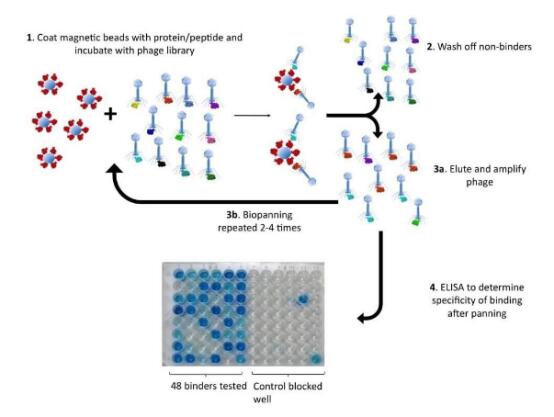
Solid-Phase Screening :
the most straightforward and widely used way to select binders against interested target adsorbed onto a solid surface. Typically, the targets can be coated on the well of immunotubes or microtiter plates for isolating specific binders.
Solution-Sorting Screening:
an ideal approach to isolate binders recognize naïve targets. The target-binder interaction is carried out in solution with subsequent capture by the appropriate method.
Cell-Based Screening:
a method in particular for cell surface antigen selection. It is a reliable approach to screen cell surface antigens with native conformation, especially when the antigen is hardly expressed as recombinant protein.
In vivo Screening:
a high throughput method for efficiently isolating tissue-specific binders. The selection is based on binding to target in vivo after the injection of interested phage libraries into whole animals, and then rescuing phage bound to specific organs and tissues.
Ex vivo Screening:
a novel technique to employ primary cell suspensions of organs and tissues as targets. All cell types can be exposed for selection to identify the most specific binders.
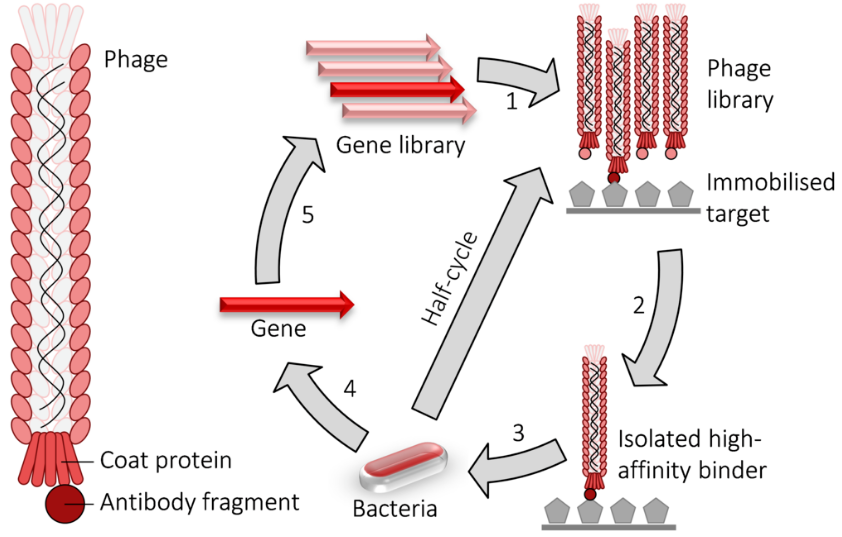
Phage Display Protocol
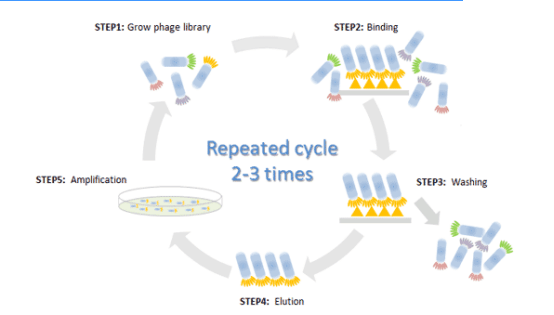
In general, there are 5 steps for phage display technology as below:
STEP1: Construct phage display library
Recombinant DNA technology is used to incorporate foreign cDNA into viral DNA. Different sets of genes are inserted into the genomes of multiple phages. Spliced into gene for a coat protein, so that the protein will be displayed on the outside of phage particles, and these separate phages will only display one protein, peptide, or antibody.
Collections of these phages can comprise libraries, such as antibody phage library, protein phage library, or random phage library.
STEP2: Binding
These libraries are exposed to selected targets and only some phages will interact with targets. The target is for which specific ligands planned to be identified such as immobilized protein, cell surface protein or vascular endothelium.
STEP3: Washing
Unbound phages can be washed away, and only those which showing affinity for the receptors was left.
STEP4: Elution
Recovery of the target bound phage by elution.
STEP5: Amplification
Eluted phages showing specificity are used to infect new host cells for amplification, or direct bacterial infection and amplification of the recovered phage.
Back to step 1, repeated cycle 2-3 times for stepwise selection of best binding sequence. After that, you can Enrichment and purification the phage repertoire by precipitation methods to increasing the phage titer.
Phage display is the technology that looks simple but hard to do. With years of experience, we can offer phage display service such as high-quality phage display library construction and custom phage display library screening services to meet your various demands precisely.
| No | Headline | Click | Author | Date |
| 1 | ScFv Phage Library Construction Service | 1392 | Leading Biology | 2020-05-27 |
| 2 | ScFv Phage Library Screening Service | 937 | Leading Biology | 2020-05-25 |
| 3 | Antibody Optimization Service | 811 | Leading Biology | 2020-05-25 |
| 4 | FcR Binding Assay Services | 1447 | Leading Biology | 2020-05-22 |
| 5 | Recombinant Antibody (IgG) Production Services | 944 | Leading Biology | 2020-05-21 |
| 6 | Recombinant Antibody (scFv) Production Services | 1176 | Leading Biology | 2020-05-20 |
Leading Biology Inc.
2600 Hilltop DR, Building G, B Suite C138
Richmond, CA, 94806
Tel: 1-661-524(LBI)-0262
Email: info@leadingbiology.com


