


Introduction
Leading Biology has established a unique platform to develop high-affinity monoclonal antibodies in rats.
Compared with commonly used mouse antibodies, rat antibodies do not have the background cross-reaction problems in immune detection of antigens out of a mouse background, such as a mouse antigen from a mouse animal model. However, Rat monoclonal antibodies are much more difficult to develop compared with mouse monoclonal antibodies, due to the lack of a stable fusion partner cell line for rat hybridoma generation.
Leading Biology has developed a proprietary hybridoma-generation platform for efficient development of high-affinity and high-specificity rat monoclonal antibodies. Our Rat Monoclonal Antibody platform allows us to offer the most comprehensive one-stop custom antibody development services in the industry.
Service Package
|
Service Items |
Time (months) |
Start point |
|||||||
|
Peptide |
Small Molecule |
Phosphate/Methyl/Acetyl-specific |
Purified protein |
Expression plasmid |
Prokaryotic proteins synthesis de novo |
Eukaryotic proteins synthesis de novo |
|||
|
Peptide design & synthesis |
Peptide design |
0.5 |
Free, Optional |
|
|
|
|
||
|
Peptide synthesis |
√ |
|
√ |
|
|
|
|
||
|
Conjugation |
√ |
√ |
√ |
|
|
|
|
||
|
Proteins preparation |
cDNA synthesis |
1 |
|
|
|
|
|
Need further inquiry |
Need further inquiry |
|
Vector construction |
|
|
|
|
|
√ |
√ |
||
|
Protein expression & purification |
|
|
|
|
√ |
√ |
√ |
||
|
Immunization |
Immune 2 rats |
1.5 |
√ |
√ |
√ |
√ |
√ |
√ |
√ |
|
ELISA detection |
√ |
√ |
√ |
√ |
√ |
√ |
√ |
||
|
Cell Fusion & Screening |
1.5 |
√ |
√ |
√ |
√ |
√ |
√ |
√ |
|
|
Subcloning |
0.5 |
√ |
√ |
√ |
√ |
√ |
√ |
√ |
|
|
Ascites production (Inject 2 mice) |
1 |
√ |
√ |
√ |
√ |
√ |
√ |
√ |
|
|
Purification and detection |
Affinity purification |
0.5 |
√ |
√ |
√ |
√ |
√ |
√ |
√ |
|
Antigen specific affinity purification |
|
|
|
|
|
|
|
||
|
Total lead time(months) |
3-5 |
-3 |
3-5 |
4-6 |
4-6 |
||||
Note:
1. Because the laboratory animals are relatively fragile, and the preparation process is complex, to prevent experimental accidents, the number of rats for monoclonal antibody preparation project is at least five, each antigen at least immune 2 rats;
2. For monoclonal antibody services, if the customer want antigen specific affinity purification rather than normal specific affinity purification, the price increases 200$;
3. We could provide prokaryotic protein and eukaryotic protein synthesis service, including free protein structure analysis and codons optimization;
4. The prices listed above are catalogue prices, the exact price need to be decided according to the actual situation of the project;
Classic case
(Rat Monoclonal Antibody Service)
Customer Provide
Protein antigen\plasmid\protein information
Process
1. Antigen preparation\Plasmid expression\Protein purification\Peptide design, synthesis and conjugation.
2. Immunization of 2 LOU/c rats.
3. ELISA/Western-blot test to monitor the antibody titer and specificity in rats serum, according to ELISA and WB test result, screening rats.
4. Cell fusion
5. Positive screening: Using ELISA test to screening the antibody positive hybridoma clone.
6. Subclone: Using limited dilution to produce subclone from positive clone, provide monoclonal supernatant to customers for tests.
7. Ascites preparation: Using rats celiac inoculation to produce the ascites of hybridoma products.
8. Antibody purification: Purify the secretory antibodies from 2 monoclonal hybridoma cell lines.
Products
(each antigen, 2 mice)
1. 2-3 immunogen specific monoclonal hybridoma cell lines.
2. Each cell line provide 10ml (1mg/ml) purified antibody, ELISA titer was above 1:50,000, WB test positive.
3. Complete lab report, remaining antigens.
Preparation time: 3-6 months
Successful case
Publication: JBC
IF:4.673
Title: Proteolytic processing of Neuregulin 1 type III by three intramembrane cleaving proteases
Name: SPP monoclonal antibody
Species: human
Type: Rat Monoclonal antibody
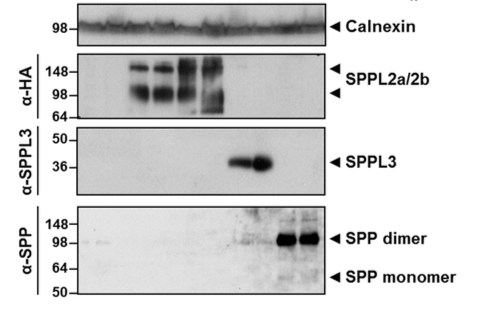
F1. The C-terminally truncated NRG1 type III NTF’ is endoproteolytic by SPPL2a and SPPL2b but not by SPP and SPPL3. HEK293 cells or HEK293 cells stably expressing HA tagged wild-type or catalytically inactive mutants (DA) of SPPL2a, SPPL2b, SPP, or SPPL3 were transiently transfected with N-terminally V5 tagged NRG1 type III (V5-NRG1 type III). Isolated membranes were subjected to Western blot analysis for protease expression control. Calnexin was used as a loading control.
Related Services
Mouse Monoclonal Antibody Service
Rat Monoclonal Antibody Service
Rabbit Monoclonal Antibody Production
Chicken Monoclonal Antibody Service
Monkey Monoclonal Antibody Service
Why Leading Biology
With over 5 years of experience in custom antibodies, we offer numerous benefits for developing your custom antibody:
Contact Information• Our industry leading titer guarantees of 1:50,000 eliminate the risk of not obtaining antibodies against peptide antigens.
• Our economies of scale allow us to pass cost savings to you and help maximize your budget.
• 100% of services are transparent throughout.
• Antibodies from our facility have been cited in many published research papers.
• By outsourcing antibody production and characterization needs to us, you can spend more time focused on your research.
• Our ideal location in California ensures that animals benefit from outdoor facilities and mild year-round temperatures.
• Confidentiality is a top priority for all projects. Antibodies that we manufacture belong to you and will not be commercialized.
Please obtain a quote before ordering, and refer to the quote number when you place an order.
Orders are typically confirmed within 12 hours.
Have a Question? Email us info@leadingbiology.com
Order Products: Order Related Products
By Phone: 1-661-524(LBI)-0262 (USA)
| No | Headline | Click | Author | Date |
| 1 | Antibody Production | 3012 | Leading Biology | 2020-01-16 |
| 2 | Mouse Monoclonal Antibody preparation by phage display | 1618 | Leading Biology | 2019-11-20 |
| 3 | Rabbit Monoclonal Antibody preparation by phage display | 1989 | Leading Biology | 2019-11-20 |
| 4 | Antibody Labeling Services | 6382 | Leading Biology | 2019-11-05 |
| 5 | Custom Monospecific Antibody Production | 2336 | Leading Biology | 2019-11-04 |
| 6 | Custom Peptide Antibody Production | 7182 | Leading Biology | 2019-11-04 |
Leading Biology Inc.
2600 Hilltop DR, Building G, B Suite C138
Richmond, CA, 94806
Tel: 1-661-524(LBI)-0262
Email: info@leadingbiology.com


