


Introduction
Microsatellite, also called Short Tandem Repeats (STRs) or Single Sequence Repeats (SSRs), is a genetic marker that can be used to locate a specific segment of genetic material that has a known location on a chromosome. Microsatellites are codominant in nature, highly polymorphic, easily typed, and Mendelian inherited, these properties made them very suitable for the study of population structure, pedigree analysis and detect differences among closely related species. The major advantages of microsatellite markers are short size range, uninterrupted stretches of identical repeat units, the high proportion of polymorphisms, insights gained in understanding the mutational process, etc. These advantages help to develop statistical procedures for interpopulation comparisons and made micorsatellite marker be a widely used marker for high-resolution population analysis.
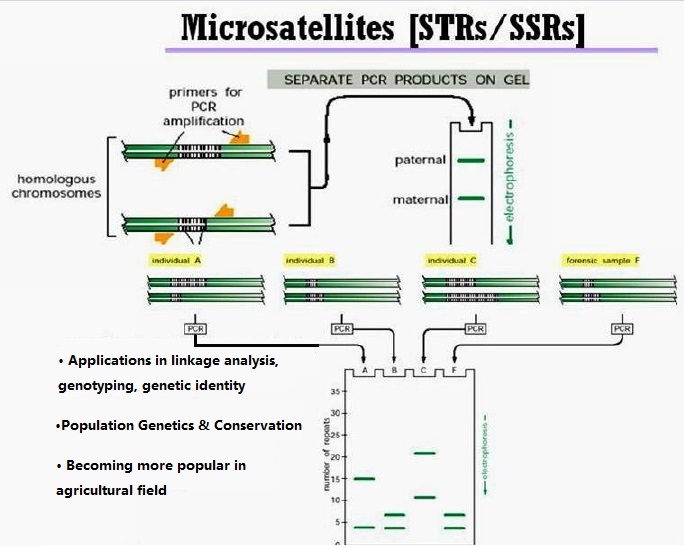
8. Sequencing and confirmation of microsatellites.
Why Leading Biology?
At Leading Biology, we custom protein purification design for every single protein to ensure the production and recovery rate as high as possible.
Working with us, you will get stability, and it means a reliable partner to help streamline your R&D process.
Working with us, you will get the guaranteed service to accommodate your requirements.
· Vigorous quality control system to ensure the required quality and reproducibility
· Competitive price with fast turnaround time
Contact Information
Please obtain a quote before ordering, and refer to the quote number when you place an order.
Orders are typically confirmed within 12 hours.
Have a Question? Email us info@leadingbiology.com
Order Products: Order Related Products
By Phone: 1-661-524(LBI)-0262 (USA)
| No | Headline | Click | Author | Date |
| 1 | siRNA/shRNA gene knockdown | 1779 | Leading Biology | 2018-01-26 |
| 2 | Tetracycline Induced Gene knockout/knockin | 1977 | Leading Biology | 2018-01-26 |
| 3 | New Generation Embryonic Stem Cells Gene Targeting | 1984 | Leading Biology | 2018-01-26 |
| 4 | TALEN Technology | 1813 | Leading Biology | 2018-01-26 |
| 5 | CRISPR-CAS Technology | 2247 | Leading Biology | 2018-01-26 |
| 6 | Microorganisms Gene Modification Services | 1711 | Leading Biology | 2018-01-26 |
Leading Biology Inc.
2600 Hilltop DR, Building G, B Suite C138
Richmond, CA, 94806
Tel: 1-661-524(LBI)-0262
Email: info@leadingbiology.com


