

> Custom Services > Molecular Biology Services > Polypeptide Synthesis, modification and coupling
Polypeptide Synthesis
In organic chemistry, peptides can be chemically synthesized by coupling the carboxyl group of one amino acid to the amino group of another amino acid molecule. Solid-phase synthesis and solution-phase synthesis are two major ways of peptide synthesis, and Fmoc solid-phase synthesis is one of the most popular ways of peptide synthesis.

Fig. 1 solid phase peptide synthesis.
After the peptide synthesis process is finished, the peptide is removed from the resin by TFA (trifluoroacetic) treatment. The protecting groups on side chains are removed by the crude linear peptide. After peptide collection, the reverse-phase HPLC is used for the purification of the peptide.
Polypeptide Modification
In research, the peptide usually needs different modifications to meet the custom peptide needs. The modifications could improve peptide stability, alter peptide structures, or enhance immunogenicity for antibody production. There are a variety of modifications of polypeptides, both terminus and internal could be modified, here are several modifications of the peptides:
1. N-terminal Modifications: Acetylation, Biotin, Dansyl, Fluorescein, etc.
2. C-terminal Modifications: Amidation, Ester, Cysteamide, etc.
3. Internal Modifications: Cyclization, Cysteine Carbamidomethylation (CAM), spacers, phosphorylation, etc.
Polypeptide Coupling
Peptide synthesis relies on efficient and reliable coupling reagents, and a low tendency for racemization is a key requirement for synthesis. Just like modification, the coupling also could occur at many sites: both on N or C-terminus and inside the peptides.
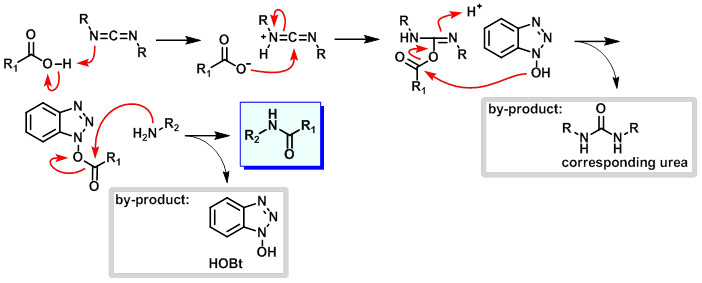
Fig. 2 Polypeptide Coupling
There are many coupling methods today, but the most successful coupling method always involves the forming of the active ester with uronium or guanidinium salts. And the most popular peptide synthesis reagents are benzotriazole derivatives such as HOBt or HOAt. DCC and EDC are often used with HOBt during the coupling process, and HOBt worked as an efficient additive during the reaction.
Why Leading Biology?
At Leading Biology, we custom protein purification design for every single protein to ensure the production and recovery rate as high as possible.
Working with us, you will get stability, and it means a reliable partner to help streamline your R&D process.
Working with us, you will get the guaranteed service to accommodate your requirements.
· Vigorous quality control system to ensure the required quality and reproducibility
· Competitive price with fast turnaround time
Contact Information
Please obtain a quote before ordering, and refer to the quote number when you place an order.
Orders are typically confirmed within 12 hours.
Have a Question? Email us info@leadingbiology.com
Order Products: Order Related Products
By Phone: 1-661-524(LBI)-0262 (USA)
| No | Headline | Click | Author | Date |
| 1 | siRNA/shRNA gene knockdown | 1737 | Leading Biology | 2018-01-26 |
| 2 | Tetracycline Induced Gene knockout/knockin | 1939 | Leading Biology | 2018-01-26 |
| 3 | New Generation Embryonic Stem Cells Gene Targeting | 1938 | Leading Biology | 2018-01-26 |
| 4 | TALEN Technology | 1781 | Leading Biology | 2018-01-26 |
| 5 | CRISPR-CAS Technology | 2204 | Leading Biology | 2018-01-26 |
| 6 | Microorganisms Gene Modification Services | 1674 | Leading Biology | 2018-01-26 |
Leading Biology Inc.
2600 Hilltop DR, Building G, B Suite C138
Richmond, CA, 94806
Tel: 1-661-524(LBI)-0262
Email: info@leadingbiology.com


